Search This Blog

Monday, August 16, 2010

What Would My Grandmother Say?

There is a rising anti-immigrant tide in this country that frightens me. It feeds on our depressed economy and is fueled by pervasive prejudices against people of color. The anti-immigrant law in Arizona epitomizes its ugly face, and elements of the right wing in this country are embracing the opportunity to assert a narcissistic frame on who is a "real American". 

What would my grandmother say?

Even though this country was founded by immigrants and shaped by the immigrant ethos -- the notion of a safe haven -- our history is also replete with contradictions, as manifested in the darker side of our past, namely Native American genocide and slavery. Let's also not forget that even when slavery was abolished, women were second-class citizens in this nation.

When I think of our nation's history, I think about my own grandmother. She came on her own to this country from Hungary around 1890, traveling on a ship in a wave of Eastern European Jews who were looking for a better life on these shores. The details of her trip are a little fuzzy because she didn't like to talk about "the past". She even yelled at my grandfather one time when he started to tell me about his childhood in Hungary. "Saul! She doesn't want to hear what happened so long ago!", she snapped at him in her thick Eastern European accent, a comment I regret to this day.

We do know that my grandmother was only 13 years old when she arrived and like so many before and after her, she came through Ellis Island. She lived for a time in Manhattan with relatives who made the same journey. At some point, she got back on a boat and returned to Hungary, to bring her parents back with her. I imagine that by this point, she was fluent in English and that they spoke none. They lived in New York City, and through her teen years she became a skilled seamstress, working in sweatshops by day and studying clothing patterns by night so she could master the skill. She and my grandfather met in New York, where they opened a "dry goods" store, which apparently is a store that sells just about anything. She had, by then, become a master seamstress, and was also a mother of nine children, all of whom attended public schools and ultimately "made good", achieving the American dream of sorts.

Of her nine children, there was one dentist, two English professors (including my father), a factory owner, an accountant, an architect, a schoolteacher, a bookkeeper and a postal worker. All but one had children of their own, 21 in all, and these children had over 20 children, and on and on it goes. With each successive generation, they are one step away from their heritage, and yet most have tried -- in their own ways -- to maintain a connection to their history.

How many people in America have some version of this story? Either they came to this country from foreign soil or the parents came or their grandparents came, to create a better life for themselves. They may have been fleeing political persecution or poverty or both. And when they came here, they struggled to learn the language, gain new skills, find jobs, and live the American dream. When they got to this country, they worked very, very hard. Many experienced discrimination, often from people who felt threatened by them in some way or wanted someone to be lower on the totem pole than them.

As Jewish immigrants from Eastern Europe, my grandparents were Caucasian. So while they experienced discrimination as Jews and as poor people, they didn't experience discrimination because of the color of their skin.


When I hear about the anti-immigrant "movement", I honestly feel sick. That must have something to do with my grandmother, as I think: Who are these people who hate people who are just arriving? Who are these people who want to close the borders? Who are these people who want to pass laws that allow English only? Who are these people who want to deny a college education to children of immigrants?

And what would their grandmothers say?

Wednesday, August 4, 2010

Surveying the Garden

As the summer is hitting its peak, our garden is proliferating with cherry tomatoes, two different kinds of lettuce, green peppers, herbs and more... I can't take credit for it, but I certainly do appreciate it!  I'm also appreciating the increased interest across this country in local foods, eating healthy and the pinnacle of city gardens:  farmers markets. It is VERY exciting that Boston will soon (1 1/2 years soon) have its own downtown farmers market, following in the footsteps of other cities like Philadelphia, Seattle and San Francisco. 


But when I think of gardens and gardening, I am reminded of my cousin, an amazing gardener and gifted health care professional, who passed away over 3 years ago after struggling with lung cancer. Here is a poem that I wrote a couple years ago, following his untimely death...


Treatment stopped and powerful medicines eased the pain
So we sat on the porch on that crisp fall day
Atop the sloping hill, gazing at the garden below
Childlike in our wonder
Timeless in a moment of joy,
Feeling the warmth amidst the cool breeze
Wind chimes serenading us gently.

"Should I live another year", you said,
"I'll build a new bed
and get rid of those tall plants to let in more sun".
Speaking quietly but resolutely,
as we sat on the porch on that crisp fall day.
Looking down at two tall grass-like reeds,
Surveying the garden and envisioning a valley of colorful abundance.

For the past two summers,
a cadre of family and friends have labored hard on this sacred land
Honoring your life and spirit with rakes and trowels, weeders and hoes,
Sprinkling the hills and valleys with greens, oranges and reds
that provide solid ground to your two young children.
Who grow stronger every day,
as they dig their fingers into rich, brown soil
that channels memories of their father through their tiny hands.

You had a plan when you surveyed the garden
from the porch on that crisp fall day
A moment of joy before things turned
The cool breeze and warm wind harmonizing
in a chorus of chimes and tears
Capturing a moment that continues to breathe
into that hallowed garden plot of land.


Friday, July 23, 2010

Walking the Fine Line of Parenting Young Adult Children

My daughter is "launched", having successfully completed her first year of college. A kid who never liked to leave home for more than an overnight with a friend, she welcomed change with curiosity, an open mind and excitement. The year went well for her on all fronts, as she plunged into new friendships and new academic challenges in a culturally vibrant city.  What else could a mom want? Happy kid, happy mom...

We have always been close, but we are becoming friends of a different sort now. At the same time, as her mother, I still feel a sense of responsibility and protectiveness towards her. How to balance these roles cannot be premeditated and planned. The balance strikes me emotionally, as it teeters back and forth depending on context and circumstance. 

This summer, our daughter decided to become an au pair in the UK, where we have family. I admired her ability to take charge and find a job in a country where she has never lived, and yet has citizenship. Refusing most of my offers of help, she planned her journey, found the host family, and ultimately took on the responsibility of caring for 3 young children, ages 4 and under for 6 weeks. Yikes! Just the sheer number of children would drive me crazy! But shortly after she arrived, adding additional stress to this scenario, the family dynamics went very sour and she gradually realized that she had to get out. My husband and I had planned a visit in the middle of her stay, and as the time drew nearer, we realized that the purpose of our visit was to help her extract herself from the situation.

The job of an au pair is well-defined in many countries, but my guess is that the majority of au pairs operate outside of any regulations. According to the British Au Pair Agencies Association:

"The au pair programme is an internationally recognised Cultural Exchange Programme. It offers a young individual the opportunity to travel and live/work with a host family in a new country, learn a foreign language and experience the country's culture. The au pair will work a set amount of hours for the host family, usually doing a mixture of childcare and light housework. The au pair may have some childcare experience, but an au pair is not a nanny and should also not be treated as a housekeeper."

In our daughter's situation, the work hours grew to 12 per day, and the children came to rely on her nearly exclusively for their most basic needs as well as constant love and attention. As tension between the parents grew, their dependency on her grew as well

In her study of what she calls the "shadow work of nannies and au pairs," sociologist Cameron MacDonald says, 

"Contemporary working mothers and child care providers are actively involved in a process of redefining motherhood. The nexus of this redefinition involves the negotiation of child-rearing practices, of who does what and what that division means." 

In our daughter's host family, the mother wanted an egalitarian marriage and the father felt that it was his wife's "duty" to be primary caregiver. They both seethed with resentment. Sociologist Arlie Hochschild says this phenomenon is the result of a stalled gender revolution, in which women are changing and men haven't yet caught up with them. The "mum" in the host family rebelled against her husband's views by going out partying with single friends at high class clubs (there's a class element here as well, of course!), and the dad rebelled by working long hours, going to the pub with his mates, and indulging in his obsession with watching car racing and playing golf. Meanwhile, the children were neglected by their parents, who preferred spending money on their vocations instead of their children. Consequently, the children were emotionally needy. 

The parents were high earners, but when it came to paying our daughter, they were stingy, nickel and diming her for cash she fronted for their children, and at times questioning the number of hours she worked for them. Since they were avoiding each other, there were times they didn't seem to know that she was the one caring for their children. And yet each of them confided in her about their marriage. Of course, it is their children who suffer the most, and as their caregiver, our daughter wanted to protect them. At the same time, she had to protect herself.

She learned that it is difficult to leave a job, particularly one in which young children are involved. She was lucky because she speaks the language, has family nearby and parents who were there to support her. But this is often not the case for au pairs... and therefore they may be vulnerable to exploitation. Au pairs become part of the family dynamic, which in a good situation can be very fulfilling, but in a negative situation, can be emotionally wrenching, as the child caregiver becomes closer to the children. It was hard for our daughter to leave, but ultimately she knew that it was time to go, and we helped her do it. Not an easy situation, by any means.


As a visitor to this host family's home, I was infuriated at how the family was taking advantage of her, but also awed by the amazing job our daughter did, providing love and security to the children and standing up for herself in the toughest of situations. To be honest, it also felt good being "mommy" again. And there is my challenge - finding the balance between a growing friendship with my young adult child and still maintaining the protective role of mother. Supporting her to walk away without telling her to do so...


Saturday, July 3, 2010

The next time someone asks...


Every so often, someone – generally some man – will ask me if I work, or even better, if I still work. In the past, this comment meant: Are you a “stay-at-home mom” (first reference), ergo, not doing “more important” work in the paid labor force; or are you retired because you’re old or don’t “need” to work (second reference)? Jeez! Most women – including those with kids – work for pay. And I’d like to think that I’m still “in my prime” in terms of my labor market participation. The truth is that, like so many Americans, I work like a maniac. Why? Because I have to; I derive pleasure and purpose from it; and hopefully I can contribute something meaningful to the world... But there’s a new interpretation to that question about whether I – or any of us – work, and it has to do with the increasing normalcy of unemployment.

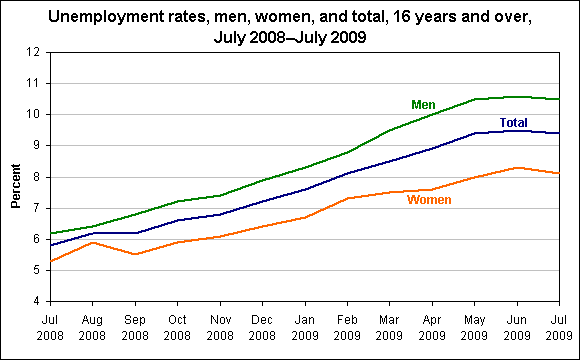
Despite all the government’s attempts at jump-starting the economy, the rate of unemployment has remained stubbornly high at around 10%. A recent rise in the job rate was more related to the creation of temporary jobs. In fact, some of my friends who got hired as census workers were part of that faux decrease in the unemployment rate, and when their jobs end, the unemployment rate will likely go up. Unemployment affects people from all walks of life, but it disproportionately affects people of color. For example, the unemployment rate for white men is 8%, compared to a whopping 17.1% for African-American men and 11.1% for Latino men. The unemployment rate for white women is 7.4% versus 12.4% for African-American women and 10.3% for Latinas.

In this current recession, men initially experienced higher job losses than women, because the industries first hit – like housing, construction and manufacturing – are dominated by men. But downsizing has become an increasingly gender-neutral phenomenon. As the recession has expanded, women are losing more jobs and at a slightly faster rate than men in key sectors like retail and service work. According to Valerie Norton, a Public Policy Fellow at the National Women's Law Center, in January, 2009, women’s unemployment was at the highest rate in 16 years and had the largest single-year increase in 33 years.

In the past few weeks, I have had numerous conversations with friends and acquaintances about the difficulty they’re having finding a job, or how they’re worried about being laid off from their current job. There’s the 20-something armed with degrees who has been thinking about launching a business and meanwhile is working in unpaid internships. There’s the highly educated manager who thought her job was stable, but her organization doesn’t have the funds to cover her, so she’s scrambling to network with contacts near and far. And there’s that person I knew ten years ago and haven’t heard from in ages who suddenly asked me to “link in”. I don’t blame her; I’d be doing the same thing.

I empathize with each of their circumstances. I’ve been out-of-a-job or underemployed a few times in my life, and because I make my living as a consultant, it could happen again. The first time I was without a job, I was in my early 20s. I had worked for a year in a psychiatric hospital and saved enough money to travel in Europe for nearly a year. I came back home – job-less – to an icy, grey Syracuse, New York winter, with no prospects or plans. Poor me… (you think). I had the time of my life, being carefree, so it’s probably hard to “feel my pain.” But I discovered a very dark place emotionally that lingered for months. Although I only had me to support, I was still terrified of the abyss that seemed to lie in my future. Ultimately, I ended up in graduate school, that legitimating haven for the unemployed (that is, those who can afford it time-wise and financially). With a nice scholarship, I had returned to the familiar womb of education, which paid off when I re-entered the job market. My second experience of unemployment was equally tough and unfortunately, I didn’t seem to have learned anything from my first experience. I was quite adept at internalizing the depression of the economy, fighting an internal battle about my value to society, until I again landed back on my feet with a new job.

Like many a sociologist, I have sought to understand life’s experiences by broadening the palette of my own mind and studying the phenomenon. Over the years, I have done a number of workplace studies, and invariably, even if the study isn’t about UN-employment, it becomes about unemployment or, equally difficult, about the challenges of working in dysfunctional workplaces. From my vantage point, most workplaces have a touch of crazy, and well-adjusted employees recognize this and maintain some perspective.

In one workplace study I did in six major corporations, examining the impact of flexible work policies on bottom line issues, two of the participating companies announced lay-offs during the course of the study. In one case, managers from around the country were brought into an auditorium, where the CEO announced the downsizing plan, charging the managers with the task of executing it. As you can imagine, the waves of fear and anger rippled throughout the corporation. In another company, the two top guys in the firm released a video which all employees watched at the same time, in which they sat comfortably in their mahogany wood-paneled office and speaking directly into the camera, announcing major lay-offs, and audaciously suggesting employees now had the opportunity to spend more time with their families. Seriously?! All the people I interviewed at that company were scrambling to figure out their next move, all second-guessing who was on “the list”. They were furious and they felt betrayed.


In another corporation, I was hired to conduct research on why people were leaving their jobs, and then the corporation announced it was downsizing thousands of employees. What were they thinking?! My work partner and I spent three years conducting phone interviews with 350 people about “why they were leaving” and invariably, the interview became a phone therapy session about how they felt betrayed by the company. In one unit, contract workers were brought in before the long-term employees left. Most (yes most) of the workers we interviewed in this unit confided in us that they were seeing a psychiatrist and taking Prozac. We just wanted to say to them, ‘Talk to your co-workers! You’re not alone!’ But confidentiality didn’t allow that…

One of the hardest hit groups is unmarried women, many of whom are mothers or caregivers. According to Liz Weiss and Heather Boushey, economists from the Center for American Progress, “The high unemployment of unmarried women, and particularly the 1.3 million unemployed female heads of household who are primary breadwinners for their families, is devastating to their financial circumstances and standard of living.” Unmarried women have much higher unemployment than married women. In October, 2009, 10.3% of unmarried women age 20 and over and 5.7% of married women were unemployed.


Losing a job usually means losing employer-supported health insurance, which is one reason why national health care reform is so critical. Weiss and Boushey report that there are an additional 276,000 children of unemployed single mothers who no longer have access to health insurance. Poverty rates for unmarried women are usually much higher than for married women (20.8 percent versus 6.2 percent of women 18 and over in 2008, the most recent data available), and poverty rates are probably higher because of growing unemployment.

At the policy level, we need an infusion of funds into job creation and job training programs, and better family policies to support women and men when they are “inbetween” jobs. Universal early childhood education, paid family leave and universal non-stigmatized family allowances would go a long way. At the personal level, it looks like those with more education experience less job loss, so this is another area that requires government policy and support.


Meanwhile, the next time some one – probably some man – asks me if I’m working or still working, I will ask for clarification. Are you asking if I’m unemployed? Do I look like I have a sugar daddy or momma? Do you really think I look old enough to have retired? Or maybe I’ll just smile and say “yes”.

From child care to early care and education: it's still a struggle...


In the early 1980s, I was radicalized by a small band of smart and committed child care workers who lobbied me when I was working for Jack Backman, a progressive state Senator in Massachusetts. First of all, as a new Bostonian who was just starting on the job, I was totally flattered that anyone would lobby me! But moreover, these incredible child care teachers were activists who loved children and understood firsthand the wage inequities for teachers caring for young children. The governor at the time called child care a “Cadillac service”, in other words, something superfluous - because women were expected to be primary caregivers for their children. But even then, 30 years ago, this view was way out of sync with the reality of women in the labor force, and especially the rise of mothers – about ½ of all mothers with infants and around ¾ of mothers with children under 5 – who continued to work for pay after their babies were born.

My child care activist buddies did their work well, and I came to believe that childcare– or early care and education as it is now called - was one of the most important issues for working parents and their children. It wasn't a hard sell for Senator Backman, who sponsored a bill to create universal child care for all. At the time, this bill seemed outrageous, the kind of outrageous that inspired behind-his-back twitters (the old-fashioned, non-techy kind). But I have learned that in the world of policy, we NEED outrageous to push the debate towards the possible...

Suffice it to say, the bill never went anywhere. Over these past 30 years, the child care movement has matured into the early childhood education movement, fueled in part by the push for educational achievement of young children, as well as by the economic reality that two-parent families need/require stable child care services to maintain economic stability. The movement throughout the country around early care and education continues to grow. There has been progress, and Massachusetts has had some notable victories. A few decades after Senator Backman’s failed legislation, a Massachusetts-based group called the Early Education for All Campaign, mobilized support among legislators and advocates around a universal pre-kindergarten bill. The bill passed, creating access to public education for all Massachusetts 4-year-olds.

But there's still a long way to go, and we could learn a lot from family policies in Europe that include paid parental leave, universal child care (that serves very young children), and non-stigmatized financial support for family caregiving…

Short of more radical change, we need to unravel some of the systemic glitches…
In a recent NY Times article (5/23: Cuts to Child Care Subsidy Thwarts More Job Seekers) - we learn that the Arizona state budget has cut funding for subsidized child care, forcing some low-income mothers to quit their jobs and instead receive state welfare benefits. These are single women who depend on their salaries to support their families. They will look for another job, but they need to keep their salaries below a certain limit to access subsidized child care.
http://www.nytimes.com/2010/05/24/business/economy/24childcare.html?pagewanted=3&sq=child%20care%20subsidy%20thwarts&st=cse&scp=1),

What's wrong with this picture? Once again - or should I say still - we see that early care and education services are critical to family survival, and our social welfare policies in this nation undermine family economic stability.

Thursday, July 1, 2010

Finding the right match...

As a devoted and slightly over-the-top ice cream addict, I approach summer with unbridled glee as I visit my favorite outdoor ice cream haunts.  (Hint: I reveal my favorite ice cream parlour at the end of this blog post.)

While I could - and do with friends - wax eloquent about the virtues of the ice cream cone, I will re-direct my focus to the topic of finding and working with an evaluation researcher. Wait!  There is one key similarity!  If you're running a program and you are required to - or choose to - work with an evaluator, it's all about finding the right match... Just like with most people and their ice cream; you have to find the right flavor for you.  If you don't eat nuts, you wouldn't be happy with pecan ice cream, right?  If you adore ice cream, you may be less thrilled about frozen yoghurt. OK, so maybe the analogy ends there...

But in the midst of this hot, steamy summer, when I am not satiating my ice cream cravings, I've been having some interesting conversations with colleagues about the important things organizations should consider when selecting and working with an evaluator. To that end, thank you to my colleagues at Arbor Consulting Partners and my virtual evaluator colleagues (see below for names).

For me, the bottom line for selecting and working successfully with an evaluator is that it's really about developing a working relationship between two parties. An evaluator brings a set of skills and a "third eye" to this venture with the purpose of helping an organization grow and thrive, and the client brings organizational knowledge and insights, as well as access to information and people that can further the evaluation process. Finding the right match is key...


There are a few things to think about:

- How do organizations find an evaluator?
- What skills should organizations look for in an evaluator?
- What should organizations tell potential evaluators about their needs?

Where to find an evaluator?  There are a number of sources out there, beginning with friends and colleagues who may have worked with an evaluator. But there are other great resources (thanks to Belle Brett) such as vendor lists kept by state departments; the American Evaluation Association's (AEA) "find an evaluator" function on its website (www.eval.org); statewide evaluation associations; department chairs of evaluation programs at various colleges and universities; and resource databases kept by private foundations (W. K. Kellogg Foundation, www.wkkf.org).

What skills should organizations look for in an evaluation?  Organizational leaders should look for someone they could trust, someone who listens well and can think intelligently about the program's goals and the extent to which it's designed to achieve those goals. Cultural sensitivity and competency may be an important factor in the potential evaluator. Organizational leaders should ask potential evaluators about their approach to working with clients and the kinds of evaluation they have done. They should get references and writing samples from a range of clients whose work is similar or relevant.

What should organizations tell potential evaluators about their needs?  Organizational leaders should tell potential evaluators what their budget is and when the project will begin. If organizations are in the process of developing a proposal, they can invite the evaluator to get involved right at the beginning. The relationship can begin right away, and evaluators can help conceptualize a new program, ensuring that the program and evaluation research designs fit the needs of the organization and are acceptable to funders.

I welcome your comments and other ideas about finding the right match!

THANKS:  Thank you to my colleagues whose ideas are reflected in this blog:  Madeleine Taylor at Arbor Consulting Partners, Belle Brett of Brett Consulting Group, Steve Gill from Consultant for Human Performance Improvement, Marty Henry at Henry Consulting, LLC, Marilyn Hwalik of SPEC Associates, Geri Lynn Peak, Dr.PH of Two Gems Consulting Services, Sheri Scott of Scott Consulting Partners, LLC, Jan Upton from Institutional Research Consultants, Ltd., and Susan Wolfe of Susan Wolfe and Associates, LLC.

And finally:  What's my favorite ice cream parlour?  How about 3?

Boston:  Kimball Farms in Carlisle Massachusetts
Pittsburgh: Bruster's 
Los Angeles:  Lake Street Creamery

Any others you want to suggest?

Monday, June 21, 2010

Why Evaluation Research is Pretty Cool...

Despite this current climate of economic belt-tightening - and maybe even because of it - there is growing pressure on organizations to evaluate their programs. More and more, funders are asking for a comprehensive evaluation plan that produces concrete data on the process of implementation and the outcomes of the program. While federal and state grants have historically required evaluation as a part of their budgets, the emphasis has  increased in this tough economy and private foundations are not far behind. Funders want to know that their money is being used to do what was promised, that the outcomes promised were achieved, or if not, that there were legitimate reasons.

Many programs approach the notion of evaluation with the fear of being judged ("What if they find that we screwed up?"), annoyance ("This is a waste of time."), or resentment. ("Why do they have to spend so much money on evaluation instead of where it belongs, in the program?").

These reactions may be influenced by people's previous experience with evaluation or a lack of it. My own first experience with an evaluator - nearly 30 years ago - was downright disappointing. I was directing a federally-funded educational program based in state government. And our evaluator "came with" the project; that is, we had no input on his selection. He "interviewed" me a couple of times and seemed friendly enough, but I never really felt he cared about the project or really understood what we were doing, nor did he make much effort to do so. He didn't seem to have an evaluation research design, didn't ask me for input on the interview protocols he used, and I honestly have no idea who he even talked to in the process of evaluating the program. 

At the end, he generated a report that was totally useless (to us at least) and didn't really resonate with our experience of the program. Nonetheless, he concluded that we had done a good job, so we were not about to argue! We could say an independent evaluator liked the program... Sad to say, my colleagues and I just thought it was a big joke. But in reality, what a waste of public dollars, and what a missed opportunity for us to actually reflect on our program experience!

A sound evaluation is focused on identifying and supporting the strength of a program, identifying the challenges, and targeting ways to overcome the obstacles. In my view, the goal of evaluation must be to help organizational decision makers make good choices about their programs and/or policies.

All evaluation is aimed at assessing some form of transformation, whether at the micro or macro level, including understanding if all the elements are in place to achieve the desired goals. In the vernacular of sociologists, I bring a "third eye" to help solve problems in diverse organizational settings, such as foundations, nonprofits and universities.


To these "clients", I am an evaluation researcher, organizational analyst, educator, strategic planner, and increasingly a management coach. Some of the questions my colleagues and I have grappled with this year include:

* To what extent do early childhood teachers benefit from state policies aimed at improving quality in child care programs?
* How can a university-community partnership overcome differences to work together more effectively?
* What role can the arts play in improving student outcomes and school culture?
* How can a foundation-initiated leadership program strengthen the nonprofit sector?

When I do evaluation planning with clients, I ask them:

Who wants to know what for what purpose?

* In other words, who is the audience for the evaluation?
* What does the audience want to know?
* And why do they want to know it?

Usually the audience for an evaluation is both internal and external. An internal audience is the program leadership and staff who need robust information about how a program is being implemented and/or developing, so it can stay on course or improve if there are difficulties. An external audience generally refers to funders or policymakers, those who require an evaluation or will use evaluation data for their own decision-making purposes.

That said, I (and most of my evaluator colleagues) often choose to work with organizations that are trying to make a positive change in society with the clients they serve, the policies they promote, the campaigns they run and/or the advocacy efforts they promote. As an evaluator, I present myself to organizations as a "critical friend" who can think big-picture about what they are trying to accomplish and who can work closely with them to understand what is working and what needs some help. 

Evaluation can play a key role in supporting program leaders and staff to make good decisions to maximize the possibility of achieving goals, or dare I say, "success", however that is defined.... And it is also key to highlighting the real world challenges programs face that may impede program success. 


Increasingly, I am finding that funders want evaluation research to document the process of program implementation, warts and all. Those of us who run or evaluate programs have known for a long time that programs will run into obstacles when they are being implemented. Evaluation can bring a wide lens to understanding and documenting these obstacles, what it takes to overcome them, or if they simply are insurmountable.

In my next posting, I will write about how to select an independent evaluator. It is inspired by my experience and that of my evaluator colleagues who have some very wise things to say. Stay tuned!  Meanwhile, here are a few quotes that relate to evaluation research because, as I said, evaluation research is pretty cool...

Everything that can be counted does not necessarily count; everything that counts cannot necessarily be counted."  Albert Einstein
"Failure is the condiment that gives success its flavor."  Truman Capote
"My mother drew a distinction between achievement and success. She said that 'achievement is the knowledge that you have studied and worked hard and done the best that is the new. Success is being praised by others, and that's nice too, but not as important or satisfying. Always aim for achievement and forget about success..'" Helen Hayes
"First get your facts; then you can distort them at your leisure."  Mark Twain
"Great things are not done by impulse, but by a series of small things brought together." Vincent van Gogh
 "True genius resides in the capacity for evaluation of uncertain, hazardous, and conflicting information." Winston Churchill
 "Each time he sees me, while all the rest go on with their old measurements and expect me to fit them." George Bernard Shaw

Friend to Groucho Marx:  "Life is difficult!"
Marx to Friend:  "Compared to what?"