Writing is a solo act, but for those in attendance at the conference of the Association of Writers and Writing Programs, or AWP (https://www.awpwriter.org/) this past weekend, you’d think it was one big party, with over 12,000 people moving through the sterile hallways of Boston's massive Hynes Convention Center to attend hundreds of sessions. I had been forewarned that this event was downright overwhelming. So before I stepped foot into the Hynes, I carefully studied the program, selected sessions that fit my criteria, and found out exactly where they were physically located. Getting lost in the Convention Center was not on my agenda! As it turned out, this surgical approach served me well.
In one day, I managed to attend five sessions, chat with five random strangers, purchase an energy bar for nearly $5, and wander around the book fair where I was invited by at least five non-residency writing programs to look at their literature. I spoke with five or so small presses about their books, and was also accosted by a woman selling a weeklong “writing trip” to Paris, which was, in sum, a total rip-off. Of my small sample of informal interviewees, a few were undergraduate creative writing majors who were totally blown away by the panoply of rich resources in one place; one was an art history professor and another was a writing professor.
But I wasn’t there to make friends, although later I joined the Women’s Caucus of the organization (yes, there is gender bias everywhere!). I was there because I’m writing a memoir about the experience of caring for my dad in his final year of life, in which I am inter-weaving my family's experience of political persecution, the FBI and more. I wanted to hear published authors talk about their experience writing memoirs, and to garner some tips about the process of publishing this type of book.
Here are a few gems that I got from the conference:
In a panel called “The Art of Losing”, authors talked about how profound personal loss fuels their writing. One of my favorite speakers on this panel was Jennine Capó Cruce, author of How to Leave Hialeah(http://www.jcapocrucet.com/), who said that she was told that she shouldn’t write from anger. But as she wrote her book, she saw rage as her source, and while writing her book, recognized that underneath her rage was grief.
In a panel called “How Do You Know You’re Ready?”, novelists shared stories about manuscripts they either sent to agents too soon or had locked in drawers, never to see the light of day. I realized that the question of when a book is complete is a universal question. The panelists seemed to agree that knowing when you’re done writing a book is a “visceral thing”. I was touched that the panelists also welcomed attendees to approach them with questions at the end of the session. I asked novelist Dawn Tripp (http://www.dawntripp.com/) for suggestions about making a “pitch” to an agent. She offered me a few tips, including “make it short and to the point”. And another panelist, Kim Wright, author of Love in Mid-Air (http://loveinmidair.com/), added that it’s important to maintain the voice of the book when you’re trying to get others interested.
In a session called “Memoir Beyond the Self”, panelists talked about the importance of writing from one’s personal experience and broadening it to reflect on cultural implications. Travel writer and journalist, Colleen Kinder (http://www.colleenkinder.com/Colleenkinder/home.html) said, “personal essays have to be brave”, and she talked about the importance of “braiding” and “weaving” different strands of a story together. In describing this braiding and weaving process, Leslie Jamison, author of Empathy Exams (http://www.graywolfpress.org/Latest_News/Latest_News/Leslie_Jamison_wins_Graywolf_Press_Nonfiction_Prize//) said that “something in one sphere poses a question that another sphere can answer”. That intrigued me.
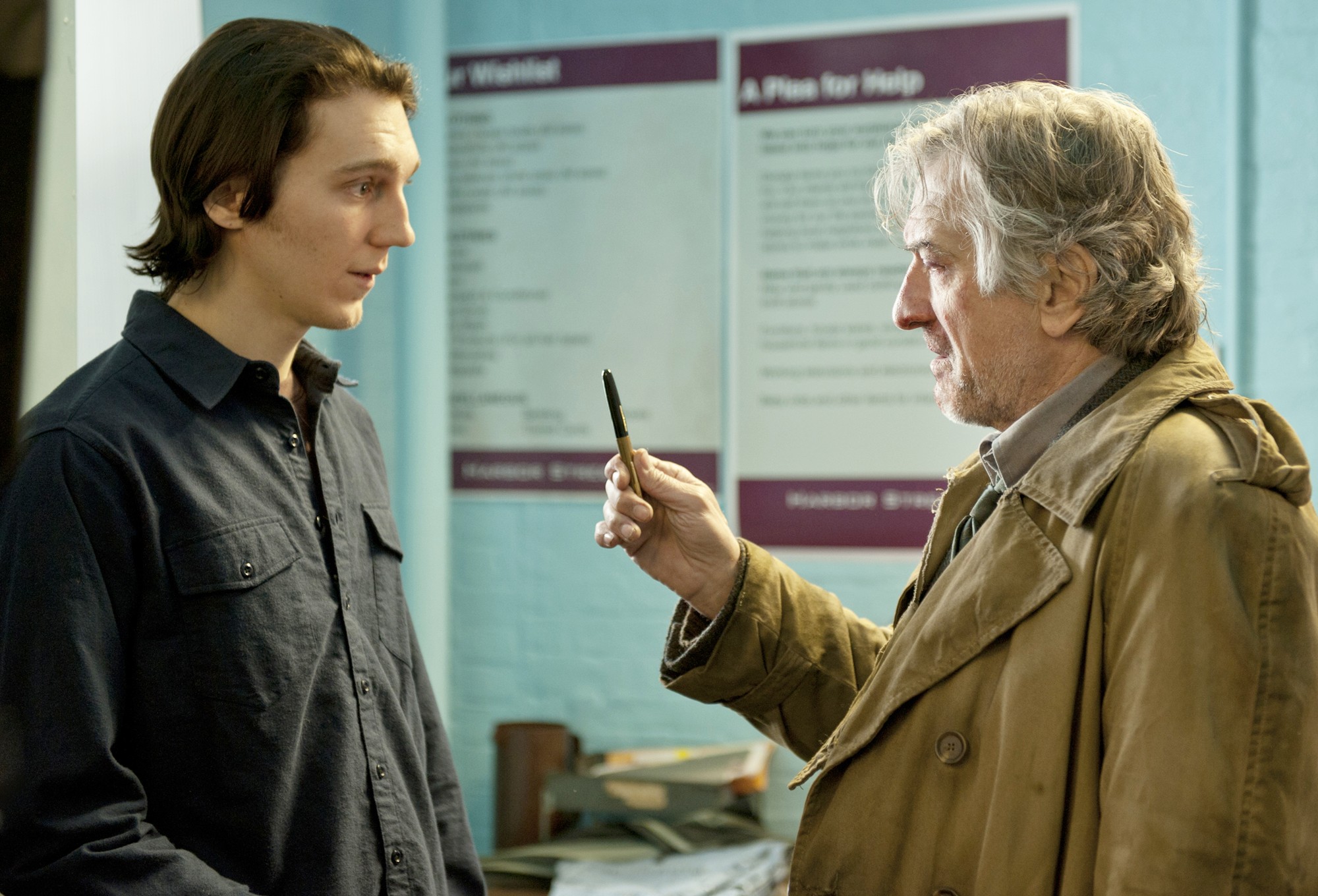
In a session called, “It’s Complicated: Memoir-Writing in the Political Sphere”, Melissa Febos talked about her book, Whip Smart, in which she wrote about her three years as a dominatrix while attending a liberal arts college in New York City (http://melissafebos.com/). Kassi Underwood talked about her book, A Lost Child, but Not Mine (http://www.nytimes.com/2011/07/31/fashion/a-lost-child-but-not-mine-modern-love.html?pagewanted=all), which chronicles her experience of having an abortion and then encountering her ex-boyfriend who was now a father. And Nick Flynn described the writing of his book, Another Night in Suck City about seeing his estranged father in the homeless shelter where he worked. The book was later turned into a film called, “Being Flynn” with Robert DeNiro and Julianne Moore. Talk about star struck!
In a session called “Poetics of Fiction in/at Buffalo”, three writers read from their work about my poverty-stricken, yet vibrant hometown of Buffalo, New York. Ted Pelton (http://www.starcherone.com/ted/) began with this poem: “Buffalo Buffalo, Buffalo Buffalo Buffalo…”, saying that no other city can be a noun, verb and adjective. And Buffalo writer of Buffalo Noir, Dmitri Anastasopoulos (http://www.akashicbooks.com/catalog-tag/dimitri-anastasopoulos/), brought the experience full circle for me, when he said, “Buffalo is all about loss”.
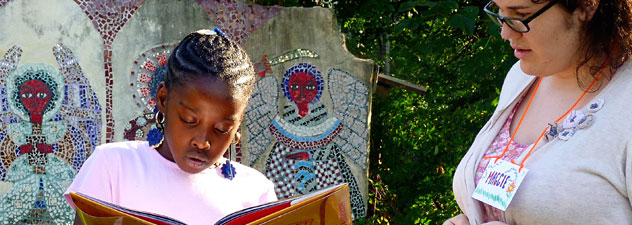
The conference had a commercial element as well: In a so-called “Book Fair”, the small presses are there to entice writers, as are the creative writing programs and artists' retreats. But one of my favorite booths in the exhibition hall was run by 826 National, a nonprofit organization that runs eight writing and tutoring centers around the country, aimed at helping at-risk youth find a voice to tell their stories (http://www.826national.org/). And who knows? Perhaps these young people will be the authors of tomorrow, and future attendees of this chaotic but enriching experience that is AWP...
The American Enterprise Institute just published a speech by G.O.P. darling and House Majority Leader, Eric Cantor, in which he calls for cutting all federal funds for social science research, insisting that the money would be better spent finding cures to diseases. He uses the story of a child named Katie who battled cancer, and who “just happened” to be sitting in the front row of his audience. "Katie became a part of my congressional office’s family and even interned with us”, he is quoted as saying. “We rooted for her, and prayed for her. Today, she is a bright 12-year-old that is making her own life work despite ongoing challenges…Katie, thank you for being here with us".
(Please note that the graphic visualizations in this post illustrate the importance of information generated through social science researchwhich have critical implications for policy, e.g., the disproportionate impact of poverty on health outcomes by race/ethnicity) .
I can imagine the emotions in that room, as the audience learns that Katie’s disease is now in remission. Some people of faith in the crowd might be thinking that prayers led to the improvement in her health. But Cantor does not invoke divine intervention. Nor does he totally discount the role that publicly funded resources may have played in helping restore Katie’s health. On the contrary, he cannily declares that there is “an appropriate and necessary role for the federal government to ensure funding for basic medical research. Doing all we can to facilitate medical breakthroughs for people like Katie should be a priority. We can and must do better”.
But investing more public funds in research on medical cures, says Cantor, would require cuts in funding for social science research. Presumably, his argument is in the interests of budgetary discipline, because it makes no sense if the goal is to improve people’s health. Less social science research dollars will only weaken our capacity to understand the critical link between the social determinants of disease and health outcomes. We need to ask: Why did Katie get sick? Was she living near a power plant or did she go to a “sick school”? What kinds of services did she have access to? What is Katie’s ethnic/racial background? What is her class background? Because chances are, if Katie is white and middle-class, her access to services are better than if she’s black or Latino and poor.
Cantor trots out the familiar conservative template: We need policies that are based on “self-reliance, faith in the individual, trust in the family and accountability in government”. He declares that the House Majority – aka Republicans – “will pursue an agenda based on a shared vision of creating the conditions for health, happiness, and prosperity for more Americans and their families. And to restrain Washington from interfering in those pursuits”.
But while Cantor frames this as a message of empowerment, his solutions will only reproduce and expand poverty and inequality. Self-reliance is code for slashing government funding. Restraining Washington from interfering with health and prosperity will mean reducing taxes for the rich. And cutting social science research will eliminate needed publicly-funded analyses that provide an essential critique of social and economic policies and their impact.
Cantor’s stance is calculated to appeal to people who are struggling in a tough economy. In his speech, he argues that in America, where two bicycle mechanics, the Wright Brothers, “gave mankind the gift of flight”, we have the power to overcome adversity. “That’s who we are”, he says. Moreover, he argues that throughout history, “children were largely consigned to the same station in life as their parents. But not here. In America, the son of a shoe salesman can grow up to be president. In America, the daughter of a poor single mother can grow up to own her own television network. In America, the grandson of poor immigrants who fled religious persecution in Russia can become the majority leader of the U.S. House of Representatives”.
All I can say is, sign me up, Eric! I’m the grand-daughter of a Russian immigrant, and maybe I’d like to become the majority leader of the U.S. House of Representatives! Honestly? I get weary when I hear about the American dream from another rich, white guy who points to exceptions to the rule, and cynically tries to generalize them.
I just came back from a four-day feminist sociology meeting, sponsored by the organization, Sociologists for Women in Society (SWS) http://www.socwomen.org/web/, in which 250 scholars from around the U.S. and beyond, shared their research about how gender, race and class affect power and status, and how these determinants affect the realities of people’s lives - including their access to quality health care, decent jobs with benefits, high quality education, freedom from discrimination, and safe environments. These are the conditions that Cantor claims should be the right of all Americans, and yet his agenda makes them all less achievable. If Eric Cantor had been at that conference for just one hour, he would have heard about the importance of social science research in understanding systems that reproduce disadvantage for low-income people, immigrants, people of color, same-sex couples and more… But maybe if you preach self-reliance, limited government involvement, and the power of prayer, even a group of brilliant social scientists won’t change your mind.
Three weeks ago, I had a freakish accident in the parking lot of my local Trader Joe’s. My shopping cart hit a pothole and overturned, and somehow the momentum took me with it, as my body catapulted over the cart and slammed into its metal bars. I wrote about the accident in a previous post, so I won’t rewind to describe details of my night in the emergency room and the generous people who helped me. But the post-accident experience was equally challenging, in part because of the physical pain, but also because of my mottled appearance. Right after the accident, my nose swelled to around three times its size, and by the next day, I also had two black eyes. Over the course of several weeks, the bruising migrated down my face until my entire face was covered in streaks of black and blue, and then green and brown and yellow. When I went to a plastic surgeon on the advice of my primary care doctor, to see if my nose was broken, he said I had experienced “major facial trauma”.
For the first week, I was just absorbing the shock of the accident and didn’t leave my house very much. But as I re-entered public spaces, I felt self-conscious and uncomfortable. Okay, part of that is vanity, but the other part is social perception, or how others were seeing me. What does one think when looking at a woman with “facial trauma”? You got it. She must be abused. Every inch of the way, practitioners asked me if I felt “safe”, which was code for, “are you being abused?” I am glad that they asked, because for some women who looked like me, the answer is resoundingly, yes. But even though the source of my battered face was a weird accident, I believe I got some insight into how women who are physically abused are further isolated because of the stigma of being a victim, a woman not in control of her destiny.
In the first few days after my accident, a couple of friends made so-called jokes about how they didn’t know my partner was abusive. It was supposed to be funny, because he is the polar opposite of aggressive. But it was not funny, and I made sure the jokes stopped. I thought about Nan Goldin’s 1984 self-portrait, called, “Nan, One Month after Being Battered”, in which she stares out at viewers with two swollen, blood-red eyes, surrounded by bruises, wearing bright red lipstick. It is shocking to see her honest portrayal, with her eyes providing a window into a relationship gone wrong.
Once again, this issue is front and center in the public sphere, as the 1994 Violence Against Women Act is up for reauthorization. This bill is critical to fighting domestic violence, sexual assault and stalking, because it funds shelters and legal support for victims of abuse, regardless of their sexual orientation or immigration status. After an initial version of the bill breezed through the Senate, it hit a wall with the House Republicans who want to limit the rights of undocumented immigrants.Now a new Senate bill has been introduced which limits the number of special visas, called “U-visas”, provided to undocumented immigrants who are victims of domestic violence and sexual assault. House Republicans also want to block current U-visa holders from applying for permanent residency after three years, which is a critical provision that encourages women to contact law enforcement without fear of deportation. Check out this January 28th op-ed in the New York times: http://www.nytimes.com/2013/01/29/opinion/violence-against-women-act-is-reintroduced.html
It’s time for this bill to pass.
As this bill is up for a vote, we have an opportunity to bring attention to the issue of violence against women in a very public way, at the national and global level. Every year, on February 14th, Eve Ensler, the author of Vagina Monologues, urges women to call for an end to violence against women. This year, she has founded, “One Billion Rising”, a global movement of “women and those who love them to walk out, dance, rise up and demand an end to this violence”. All over the world, women will be gathering to dance a simple, but beautiful dance together, in public places, as a public statement to support the end of violence, and to express collective strength and solidarity across borders. In Massachusetts, youth groups, domestic violence programs, community centers, and more are banding together to dance in celebration of women, and to protest against a culture that condones rape and accepts violence against women and girls as a given. These gatherings will be multiplied all over the U.S. and throughout Europe, Africa and Asia.
Ensler says, “One billion women dancing is a revolution!” It’s just one day, but it’s an opportunity to raise awareness of this still pervasive problem. If you're interested in joining in, there are many events being planned on February 14th, as well as days before and after, to challenge violence against women: http://onebillionrising.org/
ONE BILLION RISING IS: A global strike
An invitation to dance A call to men and women to refuse to participate in the status quo until rape and rape culture ends An act of solidarity, demonstrating to women the commonality of their struggles and their power in numbers A refusal to accept violence against women and girls as a given A new time and a new way of being
Over a year ago, I wrote a blog post about the importance of funding arts education. I'm still thinking about these issues, so here is Part Two: Save the arts because the arts save lives...
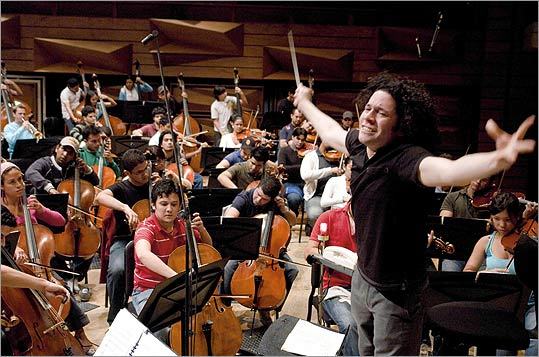
The arts – dance, theater, music, writing and the visual arts – have a powerful impact on children, opening the door to deeper knowledge and self-expression. I know from personal experience, and I have seen it in young people far and wide. While the current administration has said all the right things about arts education, this is sadly not enough, because federal, state and local policies STILL favor standardized testing and severely limit arts education funding. With all the concern about remaining competitive in a global market, this is precisely the time to fund arts education and allow our children to thrive.
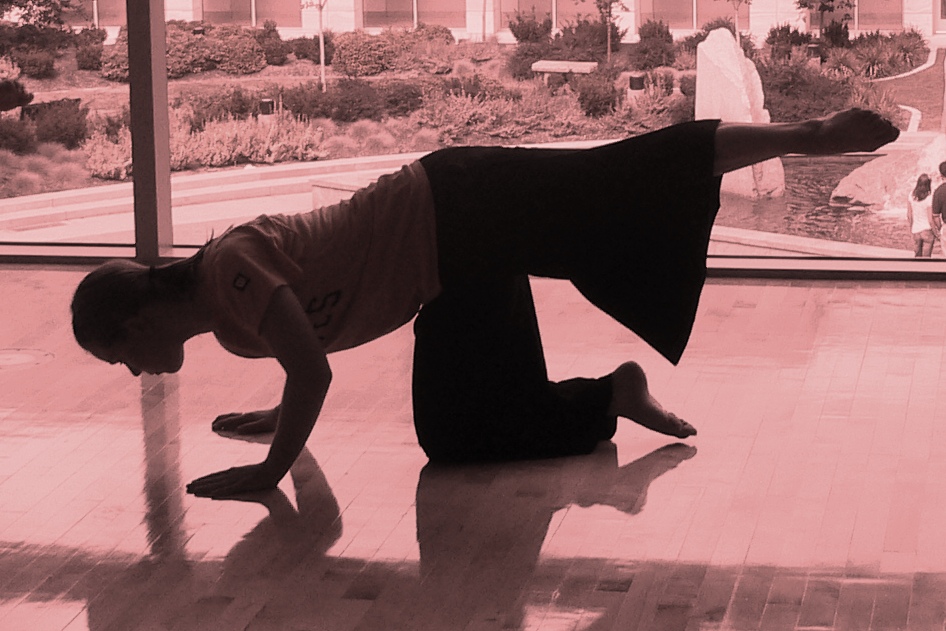
I started taking dance lessons at age seven. For the first year, I did ballet, but only lasted one year because the teacher was nasty and the movements were too rigid for my soul. Instead my mother found a modern dance teacher, Seenie Rothier, a kind and ageless woman with a lean body and tight bun (and buns), who spoke with a raspy voice as she led her charges through endless contractions, swirls and triplets across the floor. Trained in Martha Graham-style dance, Seenie, as we all called her, had a penchant for the dramatic, and yet she was the most grounding element in my life. I always assumed that my family life was your average normal, and yet looking back, I have realized that it was a household rife with angry silence and disappointment. Seenie’s studio on Hertel Street in Buffalo, was just up the block from Kaufman’s Deli where they sold frosted brownies, and down the block from my grandparents’ working class neighborhood. It was my salvation. She recognized my talent, and by the time I was thirteen, had invited me to join a college dance troupe. Dance was my manna and still is.
While it is hard to “make a living” as an artist, I tried my best, working as a dance therapist in a psychiatric hospital and later, teaching dance as a resident artist in the Syracuse, New York public school system. I discovered the magic of movement as a source of expression for young children. Often in these schools, children were marched into the gym in single file, and told to remain quiet and respectful of the visiting teacher.
Little did they know that the new visitor was about to tell the children to jump up and down like popcorn, express their joy and anger through finger dances, and shout as loud as they could, using only their eyes or feet. There was always one child in every school who attached her- or himself to me, following me around, sometimes sitting on my lap or holding my hand as I moved through the room. Sometimes I imagined that what this child really wanted was to crawl into my womb for safety. And there was always the wild child. Sometimes teachers warned me about him or her, and other times, I learned through my own encounters. If teachers were observing – they rarely participated – they might speak with the child in a stern, warning tone or pull the child away for time out. But when I could, I intervened and said ‘no, it’s okay’, because I could usually figure out a way that that child could use movement to express herself.
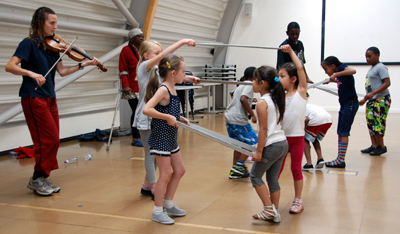
Dance is a healer, a universal mode of communication that is good for children. It’s natural. It’s great exercise. It wakes up the brain. It gives children an outlet. I have observed talented movement professionals use movement with children to help them learn science and math concepts. Dance can strengthen children’s emotional intelligence, and their ability to collaborate with others. And it can provide a form of discipline and order, when students are challenged to create dances that have beginnings, middles and ends.
A number of studies (see Critical Links) cite a positive correlation between dance experiences and nonverbal reasoning skills. One study demonstrated that “subjects” who were exposed to creative dance made significant gains in creative and critical thinking. And another study conducted with children with behavioral disorders found that when dance and poetry were combined, students’ were engaged and their social skills improved. Another study that promoted reading through dance to elementary children found that students improved significantly on all measures assessed by a reading test, including their ability to relate written consonants and vowels to their sounds.
The research on other arts modalities is equally strong, linking the study of theater to literacy, music education to improvements in spatial-temporal reasoning, achievement in reading, and reinforcement of social-emotional and behavioral skills. And classrooms that integrate the arts are a leveler for all students, including those with disabilities.
In my own research, I’ve found that teachers who implemented arts-integrated curriculum into their classroom had increased enthusiasm for teaching as they observed the positive response from students, both in terms of their attitudes towards learning, but also their ability to learn.
It’s time to broaden the policy dialogue and demand increased funding for arts education!
Last night I took a major tumble in the parking lot of one of my favorite grocery stores. I’ll set the stage: First of all, it was a winter’s dark, around 5:30 p.m., and the parking lot was poorly lit. This last fact is ironic, since the lot is owned by the high-brow lighting store next to the grocery store. Secondly, the pavement in the lot is uneven, something I had noticed in the past, but not quite in the same visceral way as I did last night. So what happened? Pretty simple. My cart, full of bags of groceries, got caught in a depression in the pavement – basically a two inch hole that is one foot wide – and keeled over. Since I was pushing the cart, I went with it. Now here’s where my mind gets obsessive, as I try to envision the physics of a shopping cart falling over. Where does it land? And which contact points on my body are evidence of its motion?
In that split second or seconds, as I went forward, my mind registered an “oh no”, until the final hit when my nose slammed into a metal bar on the cart. I still cannot figure out which bar came into contact with my nose, although I also realize that there truly is no point in knowing.
Alone in the parking lot, I stood up and disentangled from the various metal pieces of the cart and walked away, searching for some help. For anyone who has been in an accident, you know that our bodies go into shock, adrenaline creating the capacity to function, to seek out safety or help. I yelled to a woman who looked at me in horror and she asked me if I wanted her to call an ambulance. Sure, I said. Then I ambled back towards the store and was met by another woman, who said she was a nurse and sat me down by the side of the road. Other people began to gather, and I realized that I was bleeding a lot. I was oblivious to how I looked, but judging by their responses, it looked bad. Someone got me tissues, and within five or so minutes, the fire department was there, and I was surrounded by around six burly guys, until a moment later, when a policeman broke through the line of firefighters and began asking me questions.
“What’s your name, your address, your phone number? Did you lose consciousness at any time? Did you hit your head on the ground, or just the shopping cart? Is there anyone you need to call?” I was mighty pleased that I could answer his questions and that my mind was functioning.
Meanwhile, the fire truck and police car lights were swirling, as I sat quietly with my new friend, this anonymous nurse who sat by my side, a constant source of support. Somewhere in the midst of the chaos, a couple of employees from the store joined us, and left. Another shopper came up to me to say he had the very same accident a few moments before. I can’t remember if I asked him if he was okay. Oddly enough, I appreciated that I wasn’t alone. The ambulance arrived, and two EMT workers began to question me. “Did I want to get in the ambulance or drive myself to the hospital?” I couldn’t fathom driving at that point. “Was I sure?” YES, I was sure. I kept trying to reach my husband, whose phone was out-of-reach, but finally got hold of my daughter as I was getting into the ambulance, and she joined the action from afar. After I hung up with her, the EMT worker, the only dour person I encountered through this “adventure”, told me that I shouldn’t swear when I get into the emergency room, or they wouldn’t treat me as quickly. What? I wasn’t even aware I was swearing, but then I can imagine that I said a few choice words when I talked to my daughter, and then my husband. Isn’t swearing the norm when someone has been in an accident? What odd advice…
At the emergency room, things moved quickly, then slowly, then quickly. A practitioner examined me, my husband arrived, I got x-rays for various body parts, and the conclusion was that I possibly broke my nose. Not surprisingly, a few people at the hospital asked me if I “feel safe”; code for, “are you a victim of domestic violence?” I’m glad that the awareness of these issues has translated to policy and hospital practice. And truthfully, I do look like someone punched me in the face.
One day later, and the grocery store personnel are being kind and responsible. They have reported both accidents to their corporate office, and expressed tremendous regret to me. Apparently some workers arrived later last night to fill the hole where two of us tripped and fell. I am grateful that there are so many people who rise to the occasion and share their kindness in an emergency. And I wish I knew how to contact the nurse, for example, just to say thanks again, although I discovered that we live in the same neighborhood so maybe we’ll run into each other. She may not recognize me though. I’d also like to know how the other guy who fell is doing. Neither of us are spring chickens…
Which brings me to my final point… Falls for older people can be the beginning of the end. Falls are one of the precipitating factors that land older people in nursing homes. I’ve seen the impact of a fall on my own father, and the mother of a friend just died after a nasty fall. Luckily, I’m not in that category of “old” yet, but it does make you think. As an aging woman, I’m still strong and healthy, working full-time, engaged in life and ready for more. I don’t feel like slowing down, as I hear from some of my friends who are inching up to “older”. But how DO you juxtapose moving fast through the world, which I am wont to do, while having an eye towardsbalancing risk and caution? I still haven’t figured it out. Meanwhile, I will nurse my swollen face and black eye, and reassure anyone who asks that I haven’t been abused, other than by a nasty shopping cart.
As humans age, so-called modern medicine makes it possible for us to replace our worn-out parts with new and more supple ones. My beloved aunt was rejuvenated with two new knees, eliminating pain and adding a bounce to her step as she was able to walk up and down stairs once again. My father, a cousin, and a few friends have acquired new hips, which allowed them to walk, dance and even play basketball. And a number of people I know now have new lenses for their eyes, with the removal of their rheumy and unnecessary cataracts and the insertion of a new and modern 20/40 monocle. I am about to join this particular club. As these new body parts clubs go, this is apparently a fairly easy one to join. With the promise of a 10-15 minute surgery, you get a new eye and better vision almost immediately, or so they say. When asked, will you, Mindy, take this new body part into your eye socket, honor it in sickness and in health all the remaining days of your life, I gotta respond “eye do”. For the following few days, I will be journaling my experience in preparing for and securing my new lens.
Day 1: Eye drops
Holy crap, this is real! The promise of a new eye is dizzying! No more blurry headlights. No more overusing my left eye in order to write, read and well, basically, see. And yet there is a touch of sadness to say goodbye to something that has influenced my vision for several years. New parts mean leaving old parts behind. Time to move on, but am I ready? How many artists’ vision of the universe were clouded, but made more interesting, by an abnormality of their vision? Picasso? Manet? Van Gogh? I wonder if life will become less interesting? But this thought is fleeting, as I recall that I am not an impressionist artist and this cataract has become more like a veil that obscures the show.
The set of three eye drops, four times a day, for three days – first daunting in their little bottles with complicated names – are simple to administer.
Day 2: The video I foolishly watch a video of my very own doctor performing cataract surgery. I know two people who have had their cataracts taken out by him, and 100% of my small sample is very pleased. The literature is only positive about cataract surgery. Only positive outcomes for the large majority of patients, and I’ve been told that I am a candidate for a perfect outcome. Watching the video is both fascinating and terrifying. Think Clockwork Orange-scary, when a “probe” – aka small knife – goes into the eye, with viscous liquid shifting about as a new foreign object is ultimately inserted. I am thankful for the drugs that will blunt my fears and make this an “uneventful” experience, maybe even a happy one. We shall see.
Meanwhile, I’m thinking of new names for my eye. At the moment, since I’ve opted for a lens that will give me terrific long-range vision, I like the name, “eagle eye”.
Day 3: Sad This morning, I feel sad, and cannot figure out why. Nothing is feeling right, and then my partner suggests that it may have something to do with the surgery. Can that be? Early buyer’s remorse? By the end of the day, I am totally fine. Day 4: THE DAY Getting up at 5:30 a.m. is an adventure. I’m scheduled to arrive at the doctor’s office at 7:00 a.m. and I am exactly on time. The instructions were “no food after midnight”. Check. And “only clear liquid until 5:00 a.m.” Easy-peasy. But somehow when I get on the subway to go downtown for the appointment, the stomach rebels and screams, “feed me”. Once settled in at the office, I discover a stream-lined system in which patients are taken from the outer mahogany-finished office into a sterile-looking clinical area, where around eight of us are seated in comfortable chairs that recline just a bit, but are soon to become operating tables that lay flat. One-by-one, our vitals are taken by kind and efficient nurses. It turns out that my cousin’s cousin is one of the nurses, and she looks out for me, telling everyone “you gotta treat her right”!. The banter is reassuring, but I can’t imagine that if I didn’t have that connection, I would be treated “wrong!”
One by one, we are hooked up to an IV, and fairly quickly taken to the next way station, a private space separated from the masses by curtains, where an anesthesiologist comes in and asks a few questions. This is where things get a little hazy, because a combination of valium and pain medicine kicks in. I am now officially happy! I’ve read that during the surgery, the patient might see bright colors, but instead I am covered by a lovely, white, silk-like shawl that seems to wave throughout the surgery, as I look up at it in fascination. I see no nasty probes, although at one point, I do hear the whirring of a machine. I harken back to the &%* video I had watched, with my doctor performing this exact surgery, and I think I know what’s happening to me too. But la-la land takes over and I really don’t care.
Soon, I am whisked back to the original clinical room, but this time, I am wheeled over to the other side of the room, where I sit with a patch on my eye – pirate-style – and “recuperate”. Nurses offer me packaged muffins or packaged peanut butter crackers and juice. By now it’s a veritable party! I watch other discharged patients walk out with a kind nurse holding their arm, and I am waiting for my special departure, but when am told I can leave, no one hops to my side. I hope that’s a good sign that I look capable and I prepare to exit. Standing up slowly, I start to wonder if it’s a good idea, but discover that my legs do, indeed, still work.
The final station is back at the start where people sit in the mahogany-finished room, all patched up and waiting for their rides. I chat with a guy who runs a trucking business. We talk about work stuff, because I know someone who did this thing called "network mapping" for the trucking industry. The brain is functioning, albeit with a patched eye.
Later in the day: THE REVEAL After getting home, I putter around, navigating the world with my left eye, which is what I’ve been doing for a year or so anyway. Not much is different, except that I’m a lot more mellow than usual. Valium will do that. Finally, at noon, I am ready for the “big reveal”, when I take off my patch and wah-lah, the universe will come into focus! My daughter calls and I decide to video-tape the event with her on the phone. Slowly, I pull off the patch and gradually open my right eye. But instead of clarity, the universe is double-visioned and blurry. I momentarily forget the large caps on my discharge papers that say, “DOUBLE VISION OR TILTED VISION IS COMMON WHEN YOU FIRST REMOVE THE PATCH”. The video captures my restrained panic, as I say, slowly, “Wow, this is really weird!” I re-read the discharge papers, after an unnecessary call to the doctor’s office. The reassuring nurse on the other end of the phone manages not to sigh and tell me, “read the g-d paper”, and I’m grateful. Several hours later, as the temporary (and agreeable) mellow is fading, the universe is finally coming into focus.
The rest of the healing is pretty straight-forward. A follow-up appointment tomorrow, and a bunch of eye drops. A few things to pay attention to for the next 24 hours: no sleeping on the side of the operation, no bending from the waist or lifting anything over 10 lbs, and no getting the eye wet. But that’s only half the glass. It’s fine to work, to read a good book, to walk around the pond, to watch a great (or crappy) video, and eat ice cream and talk on the phone with friends and family and more…
Day 5: The morning after… I open my eyes and I am, indeed “eagle-eyed”. All right, just in one eye, but alas, there is one eye with vision that is crystal clear. It is bizarre. It is fun. It is unbelievable. Mission accomplished.
Day 6: Follow-up visit When I return the next day for a follow-up, I re-meet my trucking biz friend, and he looks about 10 years younger, post-surgery. I’m not sure why, but maybe it’s that surgery, even minor surgery, can make a person more vulnerable, and that shows. We are joined by three others who also had their surgery the day before, and I learn that the doctor performed 55 such surgeries in one day. Multiply that times a week, times a year, times all the other doctors’ offices where these surgeries are performed, and you have a veritable stadium full of new eyes.
How fascinating that we can improve the quality of our lives, even in this simple way, as we live longer. Just a few decades ago, when people had their cataracts removed, they were not supplanted with sharp lenses that improved their vision. Instead, they wore “coke-bottle” glasses that were clumsy, unwieldy and distinctive. A tell-tale sign of age. And probably in another few decades, this seemingly simple exercise in vision improvement will be even further improved.
Now we can replace body parts – new eyes, hips and knees – that make our bodies hybrids. A 17-year-old eye or a 20-year-old hip or knee matched with a 50- or 60-year-old brain. The adage that we are all the ages we have been becomes even more powerful…
As Betty Davis once said (and I paraphrase), “old age is no place for sissies”…
I don’t know about you, but for a few days – well maybe a week – I was obsessed with the soap opera that unfolded with General Petraeus, Paula Broadwell, and the Kardashian-look-alike twins who throw champagne-infused parties for the military elite. Who knew that this world even existed?! It was temporarily intoxicating. That said, this is not a James Bond story, where seduction and hot sex are intertwined with power and our country’s national security. This is the everyday horror of people making terrible personal mistakes. And I’m not surprised that as readers try to make sense of the un-reality of “the facts”, a number of narratives about who to blame have been dusted off and brought to bear once again.
According to one narrative, the blame goes to the evil temptress, a Harvard-trained intellectual and top-of-the-line athlete (read: good in the sack) who brings down the CIA chief. Think Fatal Attraction, where the woman is in charge and the man is uncontrollably gripped by her charm and power, with no alternative but to succumb. In another narrative, the blame goes to the high-level spy who takes advantage of – no, seduces – the lower-level acolyte, and just cannot keep it zipped up, despite all his medals to the contrary. Think Bill Clinton, driven by self-destruction, someone who acts first and thinks later. Hardly the image one wants to conjure up for the head of the CIA. Less prominent, but implicit among these narratives, is the role of the spy guy’s wife, who is subtly blamed for not satisfying her man. This narrative blames her because she’s middle-aged (read, unattractive), with the assumption is that she no longer has the goods. Narrative three then morphs into narrative two, which combines with narrative one, in which said high-level spy has no alternative but to explore younger, more supple, women, and one of them just happens to be out to get him. A perfect storm…
While there might be some bitter truth in all of these narratives, I’d like to focus on that last one, which capitalizes on the notion that older guys get more sexy, in contrast to older women, who get more dowdy, wrinkly and saggy as we age. This narrative has it that as women get older, we lose our appeal; we no longer shine; we fade; we become less attractive. And barring heavy use of botox and liposuction, that so-called “fact” is justification for our men to rove.
Now back to the Petraeus “affair”. Thankfully, the media is not exploiting Holly Petreaus’ story, only to say that she is furious. (Wouldn’t you be if you happened to be married to this adulterous four-star General? Okay, maybe you find it hard to imagine that you’d marry this dude…) But according to military spouse and marriage consultant, Jacey Eckhart, this telenovella (melodramatic soap opera in Spanish) has fired up fears among other military spouses, who are worried that their marriages will follow suit. http://www.nytimes.com/2012/11/16/opinion/the-petraeus-effect-on-military-marriage.html?ref=opinion
While Eckhart, a competent, articulate military spouse, knows rationally that she has nothing to worry about in her own relationship, she says the scandal has “reduced me to a wet towel and tears”. Why? Because she says that men, as they age, become more like Cary Grant, and women become more like the older “Tony Curtis”, meaning old (and kinda gay). Granted (no pun intended), military families endure enormous strains because they move frequently, and often it is the spouse who helps their family settle in a new area while the military “member” is off fighting a war (or hopefully keeping peace somewhere in the world!).
Moreover, repeat deployments place even more strain on the family, both when the military member is gone, as well as when s/he comes back, after having been traumatized by the experience of war. But separation of military spouses and their families – and ensuing loneliness – is the issue, not whether a woman can stay hot enough to hold onto her man.
Eckert laments that “history isn’t enough to keep a long military marriage together”. At the same time, she notes that military marriages end at the same rate as so-called civilian marriages. So what’s the big deal?! The problem isn’t that men will be men, and women should quiver in their boots for fear they will be cast off for a better model. The problem is that we gals sometimes internalize the societal notions that our shelf lives have expired once we hit 40 or 50 or 60. Instead of buying into – or internalizing – these lethal notions, we need to embrace the woman we are becoming, our all-inclusive selves, including our wisdom about people and life, and even the tell-tale wrinkles and sags and possibly even the dowdiness. Let’s not compare ourselves to younger women and feel self-critical. The reality is that we are all the ages we have been, and so much more. Of course, it’s important that we take care of ourselves – that we eat well, and remain active intellectually and physically; those lifestyle choices are critical if we want to live a long life. But ultimately, our worth should not be measured by our youthfulness. Even the General is now saying it was a big mistake…