Search This Blog

Showing posts with label gender. Show all posts

Thursday, April 28, 2016

Sexuality education: the battle rages on...

As published in Feminist Reflections:  https://thesocietypages.org/feminist/2016/04/28/sexuality-education-the-battle-rages-on/


My friend’s daughter, Zoe, came home from school one day and told her dad about something that happened in school. She was in 8th grade at the time, and a trainer had just come to her class to conduct a session on sex ed. She and a boy were asked by the trainer stand in the front of the room and hold two sides of a plastic heart together. One side was blue; the other pink. You can guess which side Zoe was asked to hold. The trainer then told them to pull the heart apart. When the two pieces of plastic were separated, the trainer told the class, “This is what happens when you have sex before marriage. Your heart is broken”.

healthy futures 2
When Zoe got home that day, she told her dad about it and said that it was “kind of ridiculous…stupid”. But she also felt weird about it. And so did her dad. He reached out to other parents he knew at the school, and what ensued – once the word got out – was a year-long campaign to identify who ran the program, how they got into the school in the first place, and ultimately, how to get rid of them. We discovered that the program was run by a non-profit organization called Healthy Futures, which claims it is “dedicated to empowering adolescents to avoid the health, social, and psychological consequences of risky decisions by equipping students with the tools and educated support system they need to make healthy choices”.  Their services included – and continue to include – classroom-based education, peer education through after-school and summer programs, parent education workshops, school and community connections, and web-based resources.  But when we dug deeper, we discovered that Healthy Futures was an abstinence-only-until-marriage (AOUM) program that was part of a larger entity in Massachusetts called A Woman’s Concern. Healthy Futures is considered “the intervention side” of this larger entity. Neither the website for Healthy Futures or A Woman’s Concern indicate a connection between these two groups. That can be found on a Christian website, listing them as a volunteer opportunity. The mission statement for A Woman’s Concern’s mission is as follows:

woman concern 2A Woman’s Concern is a Christian mission to women and couples in pregnancy distress, especially those considering abortion due to lack of information and support, and dedicated to providing life-saving help in a life-changing way. To this end we provide competent and caring services that include free pregnancy tests, sonograms, peer counseling and intervention, on-going support and referrals, parenting preparation classes, post-abortion healing and opportunities to learn about healthy sexual values, mature relationships and how to establish a vital relationship with Jesus Christ and His Church.   
I was in shock. What was a fundamentalist Christian program doing in a public school? And for the next year, I was obsessed with understanding more about this organization and its values, as well as learning about the different approaches to sexuality education. I wanted to understand where Healthy Futures – sponsored in stealth-like fashion by A Woman’s Concern and brought into my daughter’s school – fit along the spectrum of sexuality education curriculum.

The Case against abstinence-only-until-marriage programs
According to the 35-year-old national program, Advocates for Youth, there are a number of reasons abstinence-only-until-marriage (AOUM) programs don’t work. Of the eleven states that have evaluated the impact of AOUM programs, none have demonstrated a reduction in teen sexual activity. One strategy of these programs is have teens make a “virginity pledge”, promising to remain virgins until marriage. Researchers found that despite their promise, some “pledgers” engage in risky oral or anal sex, and if they do end up having vaginal intercourse, they don’t use condoms.

According to researchers, Hannah Brückner and Peter Bearman, even if virginity pledges help some young people delay sexual activity for up to 18 months, once they break their pledge, they are less likely to use contraception or condoms, which puts them at risk for unintended pregnancy and HIV or other STDs.
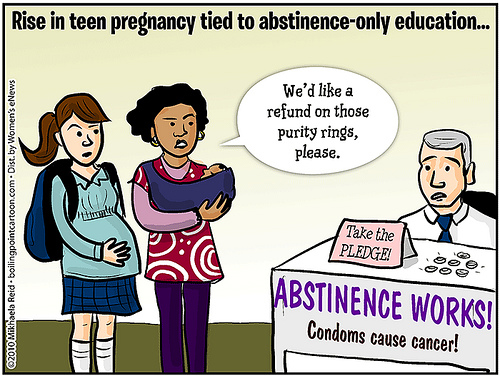
ab onlyAOUM programs often contain lies and inaccurate information. A 2004 report about AOUM programs says that over 80% of federally-funded AOUM programs contain false information about the effectiveness of contraceptives, claiming that condoms aren’t effective in preventing sexually transmitted diseases and pregnancy. AOUM programs also contain false information about the risks of abortion, with one curriculum claiming that 5% to 10% of women who have legal abortions will become sterile, will be more at risk for giving birth later on to a child with mental retardation, and that tubal and cervical pregnancies are increased following abortions. AOUM curricula blurs religion and science, presenting “as scientific fact the religious view that life begins at conception”. One curriculum calls a 43-day-old fetus a “thinking person”. And AOUM curricula “treat stereotypes about girls and boys as scientific fact”. The report concludes that these programs are a colossal waste of federal taxpayers’ dollars.
The major clearinghouse on sexuality education in the US – The Sexuality Information and Education Council of the United States (SIECUS), says AOUM programs are “based on fear and shame, inaccurate and misleading information, and biased views of marriage, sexual orientation and family structure.”

The case for comprehensive sexuality education
According to SIECUS, comprehensive sex education provides students with “medically accurate information about the health benefits and side effects of all contraceptives, including condoms, as a means to prevent pregnancy and reduce the risk of contracting STIs, including HIV/AIDS”. It teaches young people “the skills to make responsible decisions about sexuality, including how to avoid unwanted verbal, physical, and sexual advances”, as well as how “alcohol and drug use can effect responsible decision making”. Students are provided with the tools to make informed decisions. While these programs stress the value of abstinence, they also prepare students for when they become sexually active.
sex edA series of studies show that the lessons learned in comprehensive sex education programs are critical for healthy decision making during the teen years and beyond. When teens are educated about condoms and have access to them, they’re more likely to use them. When teens practice contraception in their first sexual relationship, they’re more likely to keep doing so, compared to those who used either no method or used a method inconsistently. In fact, a 86% decline in teen pregnancy from 1995 to 2002 is attributed by Columbia University researchers to dramatic improvements in contraceptive use. Only 14% of the decline in teen pregnancy rates was attributed to a decrease in sexual activity.

Researchers Starkman and Rajani found that one-half of HIV infections in the US and two-thirds of all sexually transmitted diseases (STD) occur among young people under the age of 25. By the end of high school, nearly two thirds of American youth are sexually active, and one in five has had four or more sexual partners. Nonetheless, they say, “Despite these alarming statistics, less than half of all public schools in the United States offer information on how to obtain contraceptives and most schools increasingly teach abstinence-only-until-marriage (or ‘abstinence-only’) education”.

A Short history of Abstinence-only–until marriage programs

dollarOver the past few decades, the federal government has poured millions of tax-payer dollars into AOUM programming. The two main federal funding streams for AOUM programs were the Community-Based Abstinence Education grant program and the AOUM portion of the Adolescent Family Life Act. Funding for these unproven programs expanded from 1996 until 2006, particularly during the Bush Administration. Between 1996 and federal Fiscal Year 2010, Congress allocated over $1.5 billion tax-payer dollars into AOUM programs and a significant amount of funding CONTINUES today!

Interestingly, President Bill Clinton’s “welfare reform” bill, signed into law in 1996, included a provision for AOUM programs. This funding, created via Title V, Section 510(b) of the Social Security Act, represented a shift from promoting pregnancy prevention programs to promoting abstinence from sexual activity outside of marriage, at any age. Sex was to be “confined to married couples”, and abstinence from sexual activity outside of marriage became the “expected standard for all school-age children”; with the “exclusive purpose (of) teaching the social, psychological, and health gains to be realized by abstaining from sexual activity”. In other words, these programs could not – still cannot – discuss, much less advocate for the use of contraceptives, except to focus on their failure rates. AOUM programs are meant teach that sexual activity outside of the context of marriage is likely to have “harmful psychological and physical effects”, and that it’s important for people to “attain self-sufficiency before engaging in sexual activity.”

After decades of federal support for a number of these programs, the Obama Administration and Congress eliminated the two main funding streams for AOUM programs. Congress allowed the third funding source, the Title V AOUM program, to expire on June 30, 2009. But this program was unfortunately revived as part of the health care reform package, which continues to provide $50 million a year in mandatory funding to this very day!

Power of the parents…
After discovering the AOUM program at our school, a core of parents initially gathered together and we drew up a petition, calling for the school to remove Healthy Futures and demanding comprehensive sexuality education. The support for the petition was phenomenal. Hundreds of parents signed it! Our main concern was our children’s health. We felt that it was inappropriate for a fundamentalist Christian organization, such as A Woman’s Concern, to be brought into our school. And we didn’t like the sneaky way the school had chosen to bring this program into the school.

We also wanted to know how Healthy Futures had come to our school in the first place. To our surprise, we discovered that the school’s Vice Principal had brought them. He claimed that a parent referred him and that he had no knowledge of the group’s affiliation.
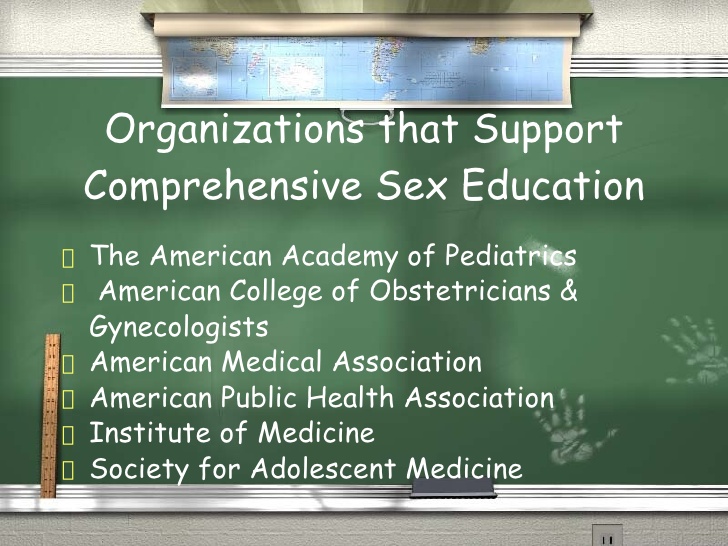
orgs comp edWe presented a statement to the school administration, accompanied by a list of over 140 organizations that support comprehensive sexuality education in public schools, stating the following:

We are concerned that the Healthy Futures curriculum is driven by a very narrow viewpoint and provides inaccurate information regarding the viability of condoms as protection against STDs and unwanted pregnancies. The (school system) has a comprehensive sexuality education curriculum that has served the system well for many years…We believe that it is in the interests of the community served by the (school system) to be given full access to the comprehensive sexuality education curriculum established by the (XX) Public Schools.

We went to dozens of meetings  – with parents and administrators – where we presented data on AOUM and comprehensive sexuality education, and we demanded that the Assistant Principal be held accountable. Under duress, he promised to review other options for the following year. We also demanded that parents and students be included in any assessment of alternative options. A number of the parent teacher meetings were very tense, because parents – particularly those who were fundamentalist Christian and anti-abortion – felt personally offended that we were organizing to get rid of this program. We let them know that we respected their points of view, but that a religiously-affiliated program didn’t belong in a public school.
we wonIn the end we won! 

After all our wrangling with the school administration, we realized that we needed to take it one level up, to the School Committee, who shared our shock that a religiously affiliated program had snuck into the school. We also presented our case to the Superintendent of the school district, and as it turned out, his wife was on the Board of Planned Parenthood. Within weeks, the program was eliminated from the district!
With this victory, parents continued to be active in a number of other school-based activities. So, not only were we successful in removing AOUM programming; we also invigorated parent engagement in the school, which spilled over to other efforts to improve the school. I was asked to be on a Sexuality Education Curriculum Committee for the school system, and spent the next year reviewing curriculum which would be brought into the schools. We ended up selecting Planned Parenthood’s excellent comprehensive sexuality education curriculum.

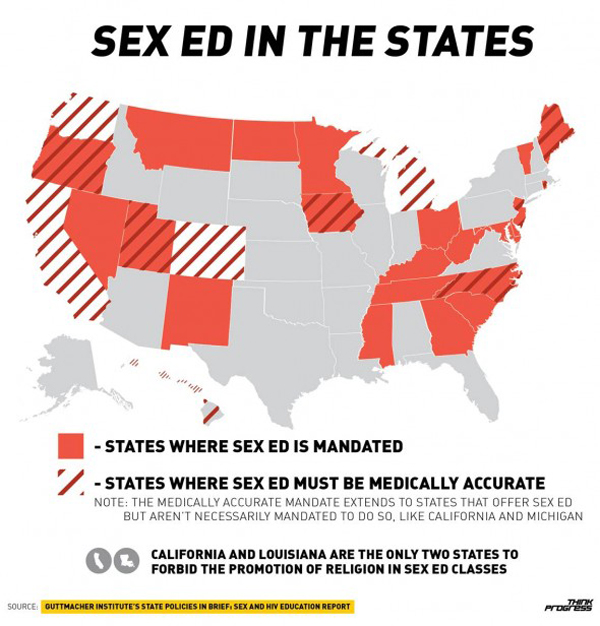
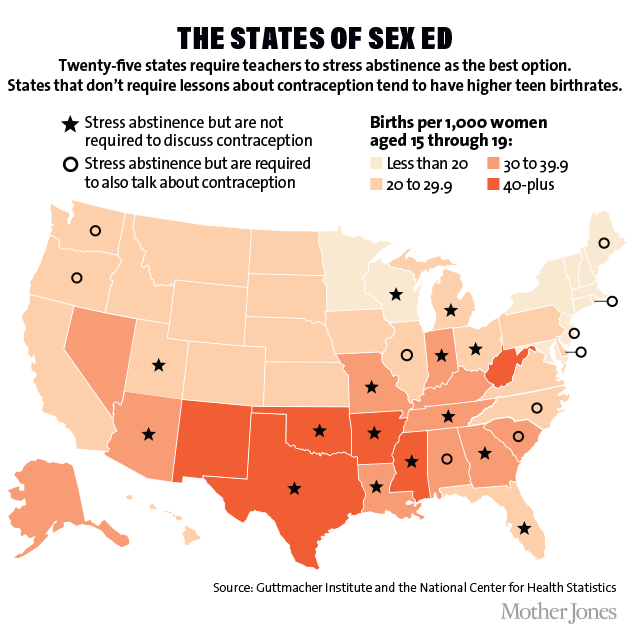
To date, 23 states have rejected Title V abstinence-only federal funding, including:  Alaska, Arizona, California, Colorado, Connecticut, Delaware, District of Columbia, Idaho, Iowa, Kansas, Maine, Massachusetts, Minnesota, Montana, New Jersey, New Mexico, New York, Ohio, Rhode Island, Vermont, Virginia, Wisconsin, and Wyoming. This is progress, but the fight isn’t over for other states and school districts. There’s still work to do…
states sex ed
FacebookTwitter

Thursday, March 31, 2016

Ode to the bra, or early lessons on becoming a woman...

This post is reprinted from Feminist Reflections.


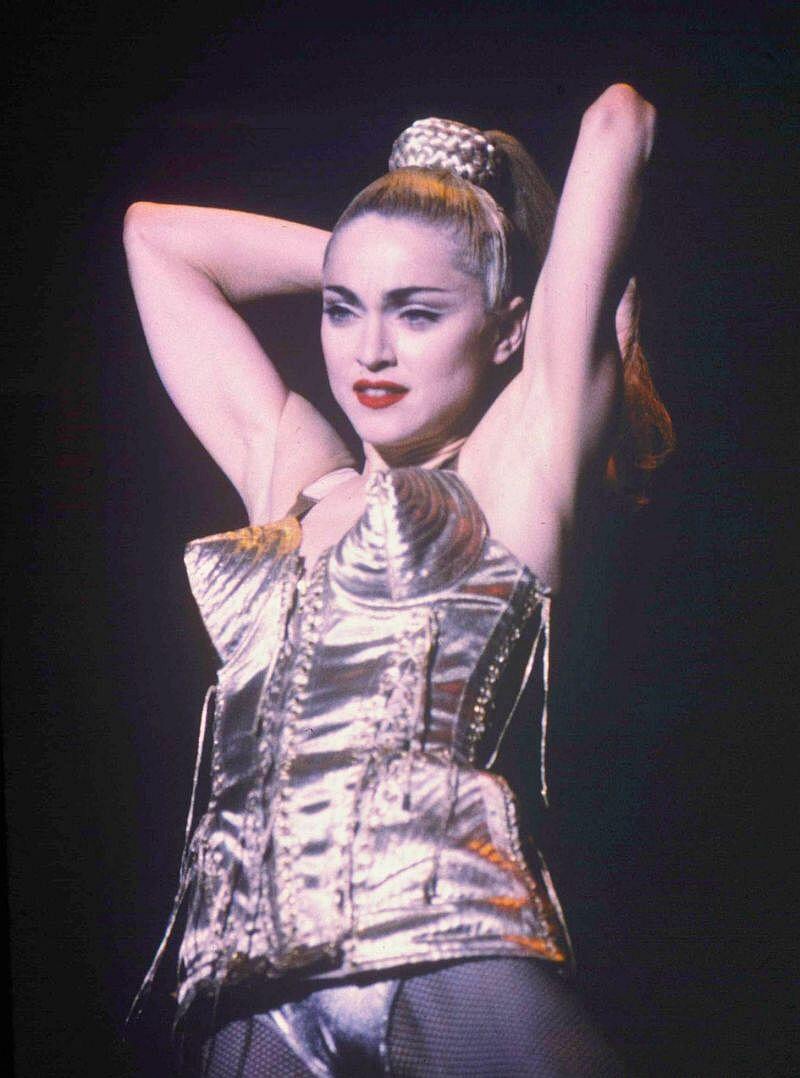
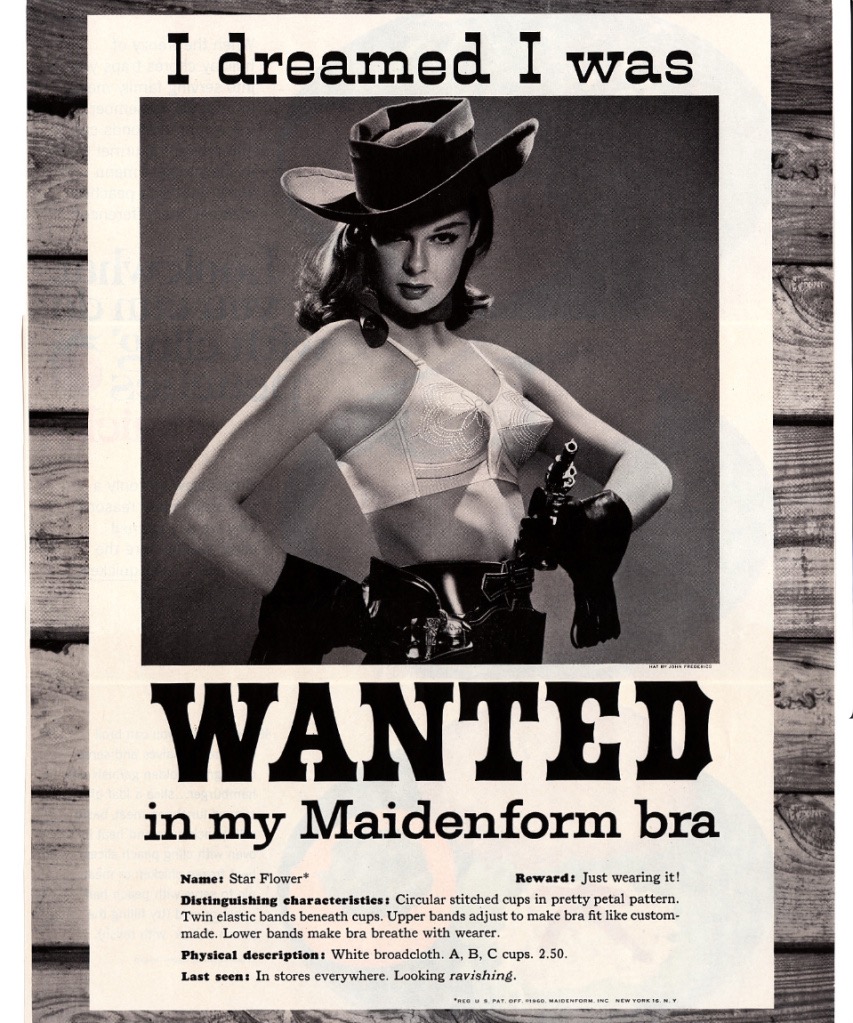
maiden madonna maiden
My childhood friend, Gail, is six months younger than me. As adults, that age differential is totally meaningless, but as “pre-teens”, it apparently meant a lot. She reminds me that when my mother took me to the local department store to buy me a “training” bra, she followed suit.  “I had to get a bra because you had one”. We both bought Peter Pan “AA”s, ironically from a company named after a boy who never wants to grow up, played in film and play versions by petite adult women.

Underneath the story of the bra (literally) is the story of the breast, that contested body part – shall we say, the ONLY body part – on women that is multiply-functioned to feed, and to receive and give sexual pleasure; a body part which is also the site of deadly disease for growing numbers of women.
Purchasing a first bra is a rite of passage into womanhood, sort of like a secular Bat Mitzvah for young girls*. And how apt that this first bra is called a “training” bar, signifying a broader issue of how girls are “in training” to be women.

While many women – particularly those with larger breasts – may need or want a bra for comfort, the reality is that bras are not anatomically necessary to support breasts. In fact, the history of “the bra” suggests that they are literally shaped by cultural norms, which are historically situated, including the economic climate, the role of technology and available materials within a particular time period. My own drawer of bras – and yes, because I’m terrible at throwing things out, I have kept bras for at least a decade – is a veritable history of the changing notion of women’s beauty, as seen through the lens of the shaping of the breast. I might even go so far as to say that the bra is an element of physical and even social control that tells one chapter of the gendered history of women.

Short history of the bra
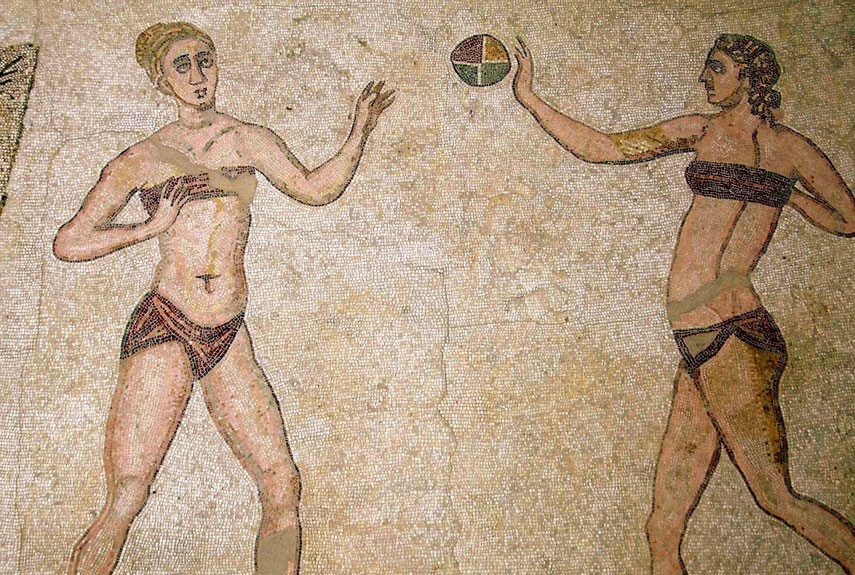
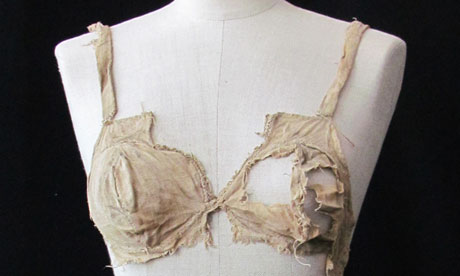
There is evidence that Greek and Roman women athletes in the 14th century wore simple bands of cloth covering their breasts while playing sports.bra ancient1
And apparently, medieval bras were called “breast bags”, which had distinct cut cups, in contrast to antique Greek or Roman breast bands. In the 16th century, women in France wore corsets which flattened the breast and pushed it up and nearly out of women’s dresses. The containing and shaping of women’s bodies continued well into the 19th century, as women were corseted from breast to hip. In the Victorian era, women’s waists were tight-laced in order to emphasize the breasts and hips.
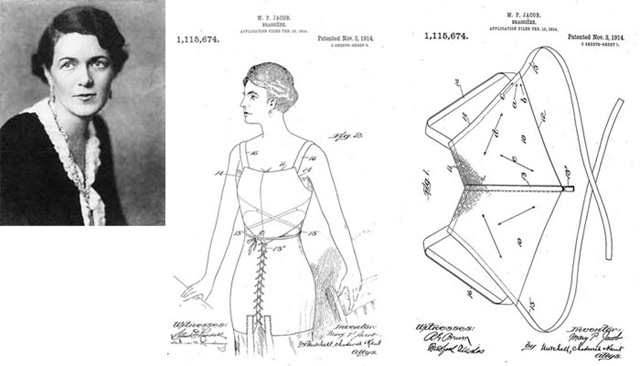
An American named Mary Phelps-Jacob is credited with inventing “the modern bra” in 1914. It was made out of silk handkerchiefs and ribbons, and she patented her design under the name of Caresse Crosby. Phelps-Jacob came from a well-to-do family, and she decided to create a bra that was more comfortable for dancing (presumably at fancy balls!).


Mary Phelps-Jacob and her bra design
She worked with her French maid, creating a design by tying two silk handkerchiefs together, sewing on baby ribbons as straps and a seam in the center front of the item. She later wrote: “I can’t say the brassiere will ever take as great a place in history as the steamboat, but I did invent it.”

By 1932, the bra company, Warner, introduced the notion of “cup sizes” correlated with letters – A, B, C and D – and added adjustable bands and eye hooks. This is the first time that breasts were no longer treated as one object; rather, they were viewed as two body parts to be enclosed separately.  Bras now used latex – as chemists had figured out how to transform rubber into textile fabric that could be woven and was washable.


bra ancient2
World War II era utility bra
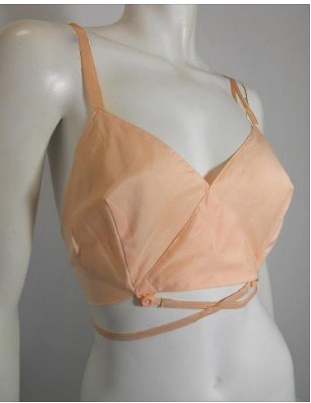
During World War II, material shortages affected the design of the bra. Some were made out of minimal fabric, called “utility bras”, and they were comprised of cotton-backed satin or “drill”, often in a peachy pink color. Women also sewed their own bras from patterns or magazine instructions, using parachute silk or nylon or old satin wedding dresses.

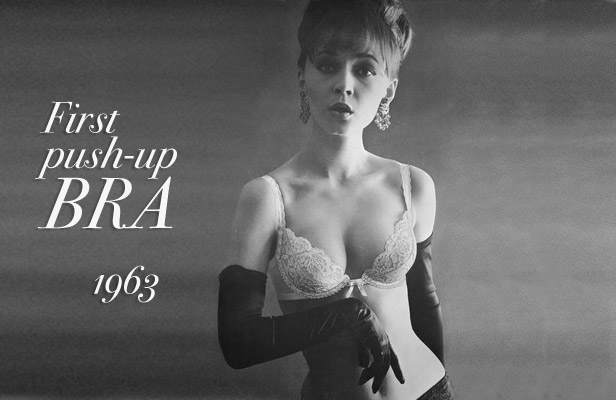
Some women began wearing “torpedo” bras, which claimed to protect women in war factory jobs. In the 1950s, after the war, women were wearing pointy bras, called the sweater or bullet bra, which drew upon war imagery. The 60s brought the push-up bra.

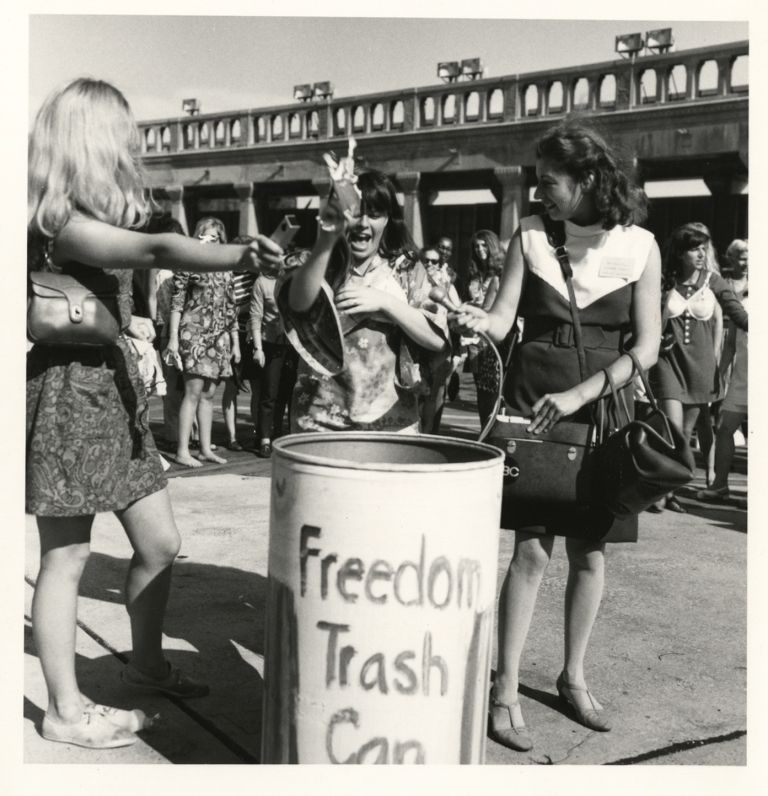
In 1968, a small group of feminists staged a dramatic demonstration at the Miss America Pageant in Atlanta, to protest the oppression of women. They picketed the event with signs saying, “Let’s Judge Ourselves as People.” And they also dumped symbols of female oppression – girdles, cosmetics, high-heeled shoes, and bras – into a “freedom trash can”.


Feminist dumping bras and make-up into freedom trash can at 1968 Miss America Pageant
It’s unclear as to whether there was any real fire at this event, much less women baring their breasts publicly. But the image of bras going into a trash can was captured in a photo, and journalists tagged these women as “bra-burning feminists”, a phrase that was meant to brand them as crazy radicals, but only contributed to the overall protest movement, which catalyzed women for action.

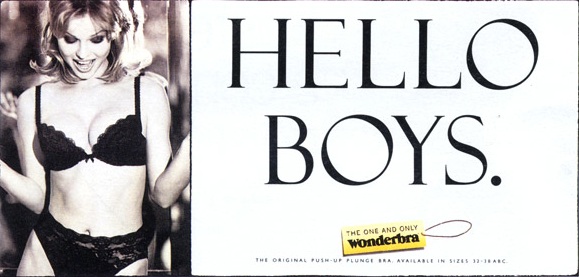
In 1977, the first “sports bra” was created, made out of stretchy rubberized material that held in women’s breasts for comfort so they could do more active sports. That same year, Victoria’s Secret opened its first store, accentuating women’s breasts as objects of sexuality aimed at the male gaze. These two bra types reflected the complex notion of women’s roles in society. In the 1990s, if it wasn’t clear what the bra was intended to do, this “Hello Boys” ad came out for Wonder Bra!


hello boys

While I know many women who would like to NOT wear a bra, these images are very compelling. Our choice to wear a bra – and particularly our choice about which bra style to wear – is consciously and unconsciously impacted by notions of the so-called ideal body shape, including the socially constructed notion of what it means to be “attractive” or “desirable”, and these notions have changed over time.

So how about today?
In the 2000s, technology has allowed the creation of the “bioform” bra – which provides a consistent shape of the breast that doesn’t rely on what’s underneath it. Pauline Weston Thomas says that this bra “uplifts and contours the breasts so well that it immediately takes ten years off a sideways sagging bust.  If you are past 40 with a full cup size you may realize that you have not seen your breasts in this position for twenty years, as it centers and uplifts the breasts.”

This new bra – made possible by synthetic materials and technology-driven design – promises to literally freeze, or even turn back, time! As we age, women’s breasts change in shape and form. They may sag, but the Bioform bra maintains a youthful veneer, or what we perceive as the young breast. The bra defines the shape of the breast, including the tilt and the amount of cleavage (think, push up bras). This bra claims to literally shave years off our age, without any invasive surgery. It’s tantamount to an anti-aging tool, and considered safe. We’re not injecting any foreign substance into our bodies when we wear this type of bra, so ostensibly, it’s not harmful. But is it necessary?

Research on bras…
Based on a study conducted by French researcher, Professor Jean-Denis Rouillon from the University of Besançon in eastern France, “bras are a false necessity”. Rouillon argues that “medically, physiologically, anatomically – breasts gain no benefit from being denied gravity.” On the contrary, he says, “they get saggier with a bra”. Rouillon spent many years measuring changes in the orientation of breasts on hundreds of women, ages 18-35, and found that women who did not wear bras had less sag. “There was no dis-improvement in the orientation of their breasts, and in fact, there was widespread improvement”. A 28-year-old woman who participated in his study and stopped wearing a bra for 2 years says, “There are multiple benefits: I breathe more easily, I carry myself better, and I have less back pain”.

So is there anything wrong with wearing a bra?  NO, of course not. And if women need a bra for comfort, want a bra because they’re modest, or want to attract men or other women with their breasts – however they want to accentuate them through the use of the bra – it’s all good!  Who am I to judge? Nonetheless, some women find “the bra” constricting and would welcome more comfort.

Here’s a great piece about a woman who experiments with not wearing a bra for a week, and discovers that she initially feels naked, discovers her breasts are lop-sided, learns that it’s not as painful as she thought it would be and eventually realizes it’s more comfortable without. She also goes out clubbing and realizes that no one notices!

And here’s another great video with a few women who try it for one week!


* A Bat Mitzvah is a coming-of-age ritual for Jewish girls signifying that they are now full-fledged members of the Jewish community with associated responsibilities.

Tuesday, March 1, 2016

Chomsky, Trump, and Challenging Bigotry...

http://cdn.running.competitor.com/files/2012/12/treadmill.jpg

A few years ago, I was on the treadmill at the gym, trying to undo a day of sitting and staring at my computer, when a casual “gym friend” joined me on an adjacent treadmill. She noticed that I hadn’t been there much lately, and wanted to know why. I didn’t know her well and could have manufactured some quick story, but she had always been so warm and friendly, so I decided to tell her the truth: my 97-year-old father had passed away. Her response was immediate and kind, as she empathized with how hard it is to lose a parent. Then she looked up to the ceiling of the gym, and as I followed her gaze wondering what had stolen her attention, she said in a reassuring voice that “he is in heaven now,” and then looked back at me with a smile. Not knowing how to respond, I smiled back wanly and increased the incline on the treadmill. I wish I could believe my dad was in heaven and, as my partner says, I hope to be happily surprised…


She then asked about the funeral, and I explained that we had it right away because I’m Jewish and that’s what we do. Apparently distracted by the realization that I was a Jew, she paused, and then told me that she had many arguments with her Catholic friends who believe “the Jews killed Christ.” (Wait a minute – where did that lovely empathy go?!) Just as I was thinking about an exit strategy, she came back to earth and said, “It’s crazy that people of all faiths don’t get along.” And as I was mentally excusing her for that detour, she added, “except for the Muslims.” With those words, I was hooked again. I looked back at her and must have appeared surprised because she smiled uncomfortably…and then told me she worried that Muslims – presumably all Muslims – were terrorists. Wasn’t it time for me to leave the cardio area and work on my abs or something? But no, I couldn’t leave now because I saw this as a “teachable moment.”

Her comments really irked me. Here was a kind-hearted, well-meaning person who lacked real knowledge about Muslims, and seemed to be swallowing whole the Fox News/right wing extremist narrative. It upset me that people like her – presumably good people – can be so vulnerable to wrong thinking. Moreover, the current array of bigoted GOP candidates – fueled by and reinforced by right-wing media outlets – are able to reinforce people’s fears into a frightening political direction.

http://www.usnews.com/dims4/USNEWS/976e756/2147483647/thumbnail/652x454%3E/quality/85/?url=%2Fcmsmedia%2F84%2F1d%2F46a5f6984d0ab8c82e04377eb88a%2Fresizes%2F1500%2F150909-immigrants-editorial.jpg

In his analysis of why Donald Trump is gaining traction in this presidential race, scholar and activist Noam Chomsky says that Trump is “evidently appealing to deep feelings of anger, fear, frustration, hopelessness, probably among sectors like those that are seeing an increase in mortality, something unheard of apart from war and catastrophe.”  Trump supporters, he argues, “are sinking into hopelessness, despair and anger”.  Instead of directing these feelings against the structures and institutions that are “the agents of the dissolution of their lives and worlds”, Trump incites people to blame “those who are even more harshly victimized,” including Muslims.  Add to this the fact that Trump is an entertainer! He cushions his message of hatred of “the other” with the bombast of a reality TV delivery. Chomsky warns us that these “signs are familiar,” as they “evoke some memories of the rise of European fascism.”

http://christewtechproject.weebly.com/uploads/1/4/4/8/14485152/1351702220.jpg

I hearken back to the consistent message I heard throughout my life from my political activist father – that we must stand up for our beliefs. In the 1940s and 1950s, he was a very effective union organizer, fighting for better wages and working conditions for working men and women. But in 1954, he was called before the House Un-American Activities Committee (HUAC) to answer the now-infamous question, “Are you now or have you ever been a member of the Communist Party (CP) of the United States?” After much emotional wrangling, he decided to challenge the committee’s legality. As a result, he was “blacklisted” from employment in the U.S. and could only find work selling life insurance for 15 years through a Canadian firm. Again in 1965, he was subpoenaed to testify before the Committee. By that time, he had become a prolific playwright, writing about his experiences within the labor movement in an attempt to give voice to working people. His life choices affected his family. We lost friends and were rejected by family members. And yet I have internalized – without a doubt – the importance of challenging injustices.

So what did I say to my treadmill partner when she brought up her fear of radicalized Muslims? I told her that the media would like us to believe that all Muslims are terrorists, but most Muslims are peaceful people. Didn’t the “Koran incite Muslims to commit terrorist acts?” she asked. I replied that I knew that was completely false, drawing upon knowledge I have gained over the years.

Did I say enough to challenge her thinking? I’m not sure. There is that moment when we may ask ourselves, “Am I going to challenge this person? How do I do it respectfully? Am I risking their wrath? Will I feel uncomfortable? While it might be a conversation with just one person, I have no doubt that these interactions can make a difference in changing people’s minds. Maybe they will be more thoughtful or less reactive. But I believe that if we remain silent, we are – in a way – complicit.

There are many ways to fight misinformation and to work for a better, more equitable world. We can organize, write, teach, and, sometimes, just talk with a friend, colleague, or acquaintance. And we shouldn’t be afraid to do so.

FacebookTwitterGoogle+

Sunday, September 6, 2015

The SWAN STUDY: Gender, Identity and Menopause


I sit opposite Lila [1], the 25-year-old research assistant, in a small room at a satellite office of Mass General Hospital. She is warm and professional, and we have already discovered that she went to college at the same university where I went to graduate school. She took classes with some of my favorite professors, and we may have been in the same room at one point, when I came back to give a talk on campus. This is a nice ice-breaker. But now, in this room, Lila is in the driver’s seat. She has just finished asking me a load of questions about my health, lifestyle, and social networks. I will be there a total of four hours by the time I complete the entire process, which includes a bone density scan and a few other tests they’ve added this year.

SWAN AA woman hot flashIn 1996, right after I completed my Ph.D. in Sociology, I was randomly selected as one of 3,302 women from diverse racial/ethnic backgrounds to participate in this mid-life women’s health study called SWAN – or Study of Women's Health Across the Nation. The study is following women as we transition through menopause, to better understand the physical, biological, psychological and social changes we experience during this period. SWAN aims to help scientists, health care providers and women “learn how mid-life experiences affect health and quality of life during aging”. [2]

SWAN participants or “subjects” were all between 42 and 52 years old “at baseline” – that, is, when the study began – and we represent seven cities around the country, including my own city of Boston.

When I got the call inviting me to join the SWAN study, I had just completed a lengthy project that involved a lot of interviewing. I welcomed the opportunity to answer someone else’s questions! It also felt great to be a part of important research that had the prospects of influencing medical science. But when I said "yes" to participating in SWAN nearly 20 years ago, I could not have predicted that I would be interviewed by at least 10 or more 20-something research assistants, most of them en route to medical school following this "real-life" experience. 


Last year, there was a funding hiatus for the study. I was having a tough year myself and barely noticed that I hadn’t gotten my annual call to set up an appointment. Then a month ago, a letter arrived. SWAN was back in biz, and I’d be getting a call soon! I was thrilled that the study was re-funded in this era of budget cuts for basic science and social science research. I was also feeling grateful that my health was back on track. It struck me that SWAN gave me a regular opportunity to reflect on my life’s circumstances, and to think about how I’m handling growing older, even if it’s only because of a series of questions read to me by a young research assistant whom I've just met.

Lila was trained to draw blood, and as she jabs me with the needle, I think, wow, she’s pretty good. We continue to chat, as she measures my waist and hips, clocks how fast I can walk down the narrow hallway, and how long I can balance in a variety of different positions. I'm feeling pretty cocky, until we get to the cognitive test, which they instituted about four years ago. Even though I think my memory is pretty good, being quizzed by a millennial is unnerving. I tell Lila that this test makes me anxious, and she says “yeah, everyone hates it”. That’s only somewhat reassuring, but I appreciate her attempt to normalize my response. Once it’s over – after I spat back a series of numbers and letters in order, and re-told a story about three children in a burning house being saved by a brave fire fighter – I tell myself, “good enough”. That was something my father used to say in moments of stress.

The SWAN Study has taken care to ensure that we are a diverse sample of participants.
Prevalence of hot flashes by race/ethnicity
In Boston, researchers over-sampled African-American women, meaning that the study has intentionally included a larger percentage of African-Americans than are represented in the general population. Other cities have ensured that the sample includes large numbers of Chinese, Japanese, and Hispanic women. This oversampling strategy allows researchers to investigate the influence of race and ethnicity on health outcomes of women as we age.

SWAN-affiliated researchers, Drs. Robin Green and Nanette Santoro, found that most symptoms of menopausal women varied by ethnicity. They write,

“Vasomotor symptoms were more prevalent in African-American and Hispanic women and were also more common in women with greater BMI, challenging the widely held belief that obesity is protective against vasomotor symptoms”.

They also found that vaginal dryness was present in 30-40 percent of SWAN participants at baseline, and was most prevalent in Hispanic women. But even among Hispanic women, “symptoms varied by country of origin”. The researchers conclude that “acculturation appears to play a complex role in menopausal symptomatology” and that “ethnicity should be taken into account when interpreting menopausal symptom presentation in women”.

By including an ethnically diverse sample, the SWAN Study is able to compare the experiences of women from varied backgrounds, which has pointed to important differences that should be of great benefit to health care practitioners. Moreover, SWAN researchers provide participants with information about our health, and flag issues we should explore further. For example, I discovered that I had high cholesterol, something that runs in my family. I’m now being monitored by a specialist, who asked me to take a very lose dose of a Statin. And overall, I’m more conscientious about my diet. The upshot is that my cholesterol levels are under control.

Gathering the SWANS...

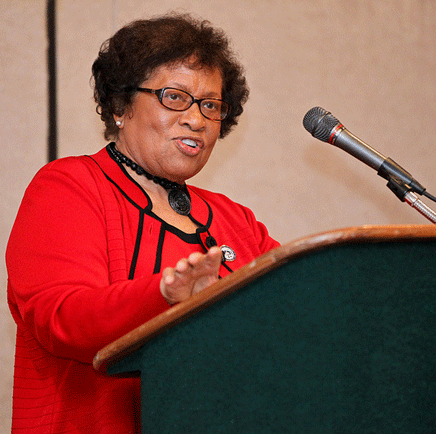
Jocelyn Elders, former U.S. Surgeon General
In the past couple of decades, the SWAN team held a number of gatherings to bring Boston SWAN “subjects” together. It's awesome to be in a room with hundreds of women with one thing in common: we are mid-life women who have gone through menopause! What fun to talk about all the crap we are experiencing without feeling judged or worrying that we might be boring someone.

The first gathering I attended offered workshops where “experts” could answer our questions about sleep (like hot flashes keeping us awake) or provide us with alternatives to Hormone Replacement Therapy. One year, SWAN researchers organized an event that featured the brilliant and outspoken Jocelyn Elders, former U.S. Surgeon General who was a lightning rod for speaking her mind, in support of legalizing marijuana, the distribution of contraceptives in schools, and even suggesting that masturbation might be a means of preventing young people from engaging in riskier forms of sexual activity. Sitting in a diverse crowd of mid-life women and cheering for Elders, whom I have admired for years, was positively thrilling.

Lila tells me a little about this year’s gathering, which I unfortunately missed. I learn that one of the Boston-based Principal Investigators, Dr. Joel Finkelstein, is a serious art aficionado and at the last SWAN Study gathering, he showed a series of paintings by an older woman. His message was that we can continue to grow and be creative as we age. When the interview is complete, Lila hands me my gift. In past years, it has been a cup or a small tote bag, marked with the graceful SWAN logo. But this year, it’s a small box, the top graced with a floral design from this artist.
Gift from SWAN Study
In the abstract of his 2014 application to the National Institutes of Health, Dr. Finkelstein concluded by saying, “SWAN will fill important gaps in understanding the impact of the menopausal transition and mid-life aging on women's health and functioning in the postmenopausal years. Accordingly, it will provide useful information to guide clinical decisions in mid-life and beyond in women who have diverse life experiences and socioeconomic and racial/ethnic characteristics”.

I'm grateful to be a part of this longitudinal study, to know that the aggregate data being collected reflects a diverse population of women, and that we are collectively contributing to scientific knowledge that can improve the lives of women as we age.

Finally, here’s a great clip from Menopause, the Musical!, just for funhttps://www.youtube.com/watch?v=ndFBFXV3jjs


[1] Fictitious name
[2] The SWAN Study is co-sponsored by the National Institute on Aging (NIA), the National Institute of Nursing Research (NINR), the National Institutes of Health (NIH), Office of Research on Women's Health, and the National Center for Complementary and Alternative Medicine.

Saturday, July 4, 2015

Insomnia stories...


The men in my family were easy sleepers. It wasn’t uncommon to see my father and his six brothers lie down on the floor after a big meal and just nod out. Of course, that left my aunts to clean up, after they had also cooked the meal, and I bet they could have used a nap too. At the time, I figured that taking a post-meal snooze was the “way things were” for the men in the family. But gradually, as I developed a feminist consciousness, I resented these lazy guys. As my age gradually crept up to where theirs were back then, I have begun to appreciate their supreme capacity to sleep just about anywhere, anytime. My father was also one of those people who could nod out for five minutes – taking a so-called “power nap” – only to emerge refreshed and able to fully re-enter the conversation when he awoke. 

Later, when he was in his 90s, he began to experience serious insomnia, lying awake for hours and hours throughout the night, going crazy with boredom and frustration. While I sympathized with his dilemma at the time, it wasn’t until I experienced my own sustained insomnia – after a back injury – that I understood how horrible it is to not be able to sleep night after night. I discovered that sleep deprivation steals one’s energy, one’s optimism, and sometimes even one’s sanity. With increasing lack of sleep, the exhaustion compounds and the world becomes slightly, if not majorly, off-kilter. 


Insomnia is a lot of things, which includes having a hard time getting to sleep, as well as waking up early and having a difficult time getting back to sleep. Not surprisingly, it isn’t a contemporary phenomenon. No, we in the so-called modern world didn’t invent it. Insomnia goes way, way back. The term “insomnia” first appeared in 1623, and means “want of sleep”. One of the biggest causes of insomnia, stress, is something that people have been struggling with for eons. It’s just the nature of stress that looks slightly different these days, compared to a few centuries ago. But if you think about it, there are a lot of similarities. 

We’re stressed because we work hard or we don’t have enough work. We’re stressed because we live in a violent world that is unpredictable. We’re stressed if we experience social isolation or prejudice. We’re stressed when we don’t have enough to eat, and don’t know where the next meal is coming from. We’re stressed because our jobs are too demanding or not challenging enough. We’re stressed because we worry about paying our bills. We’re stressed because we don’t feel loved enough, or because we have tension with our partners or our friends. One might call these universal problems, and these stressers will vary based on your economic situation as well as your race, gender and sexual identity. And maybe a few centuries ago, we might have also worried about predators or major diseases that wiped out entire swaths of people. All of these stressors can lead to loss of sleep. 


A lot of famous people are recorded as having suffered from insomnia. Sir Isaac Newton suffered from depression and had difficulty sleeping. Winston Churchill had two beds because if he couldn’t sleep in one, he would try the other. Thomas Edison, like my father, was a cat-napper, because he couldn’t sleep at night. Some insomniacs turned to drugs. Marcel Proust and Marilyn Monroe took barbiturates to help them sleep. English writer, Evelyn Waugh, took bromides to induce sleep. As we know, Michael Jackson died because of a lethal cocktail of medications to help him sleep, including propofal, used for sedation before surgeries, lorazepam, used for anxiety, and a host of other meds, including midazolam, diazepam, lidocaine and ephedrine. He was obviously so desperate to sleep that he was willing to try them all. 

Author and columnist Arianna Huffington calls insomnia a “feminist issue”, and has written columns in Huffington Post lamenting her lack of sleep from jet lag. Another Huff Post columnist, Dora Levy Mossanen, calls insomnia a “smart, devious virus that mutates and changes form every season like the flu virus. Except that this tricky bugger is tuned to our circadian rhythm and is able to change and disguise itself at whim to confuse the heck out of us”. Mossanen does all the “right things”: She doesn’t drink caffeine, goes to bed at a decent hour, drinks hot milk before bedtime, takes warm baths, reads non-stimulating books, listens to guided meditation on her i-pod, and imagines serene seashores. And yet she says, “I toss and turn at the beginning of the night, counting backwards and forwards so many times that if my mind was prone to mathematics, I'd have solved all the mathematical problems of the world by now”. 

For the most part, my insomnia has cleared, but every so often it rears its ugly head. While in the midst of a minor insomniac “relapse”, I asked my friends and colleagues for their insomnia narratives. I wanted to know how long their insomnia lasted, why they thought they were struggling with sleep; what they did when they were awake; how it affected them the next day. I learned that the main causes of insomnia are: 

* Anxiety, the everyday kind like preparing to teach a class, and larger anxieties, like worrying about keeping a job; 
* Depression, which impedes relaxation necessary to fall and stay asleep; 
* Medications, because some meds like decongestants and pain meds keep us awake. Antihistamines might initially make us groggy, but they can cause excess urination which gets us up a lot during the night; 
* Alcohol, which may make you more relaxed, but prevents deeper stages of sleep and can cause you to wake up in the middle of the night; 
* Chronic pain, which is distracting and worrisome and can lead to anxiety, which prevents sleep; 
* Medical conditions, like arthritis, cancer, heart disease and Parkinson’s disease, which are linked with insomnia; 
* Poor sleep habits, like weird sleep schedules, or an uncomfortable sleep environment; 
* "Learned insomnia” – which is worrying too much about not being able to sleep, which makes it hard to get to sleep; and 
* Eating too much before sleeping or eating the wrong snack, which can give you heartburn and make it uncomfortable to fall sleep. 

In response to my call for insomnia stories, only women replied. I know that isn’t because men don’t experience insomnia; but perhaps men don’t want to reveal their sleeping problems publicly, even though I promised confidentiality. (It's not too late, for my male readers!)

One woman said, “You do realize you've opened the floodgates, yes? Amazing topic. Of course, I'm too sleep-deprived and deep into end-of-semester madness to respond right now! Maybe during my next bout of insomnia (perhaps tonite). ;-)” 

Here are a few responses from other insomniacs: 

One woman says, “Funny you should ask, as I am suffering from insomnia just now, maybe a week long bout this time, but by far not the longest ever. I wake up about 4am and cannot fall back asleep if my life depended on it. Not sure why I have such a hard time staying asleep, maybe it's hormonal (menopause) or maybe it's all the craziness at the office (new department chair, no office support as the old secretary retired, research lagging, ...). Often I am not the only one awake, as my spouse is also a stressed-out insomniac. I typically try to fall back asleep, but if it doesn't happen, I get up and read in the living room until I feel exhausted from being up at 4 am. What sometimes works is counting backwards from 100 in another language. Needless to say, the next day I feel a bit out of it, but nothing like the "zombieness" I did when my child used to wake me up. I am not desperate yet, but may try to find my melatonin from the previous bout to get me back on track. Sometimes it works, sometimes it doesn't". 

Another woman says, “My insomnia stories are boring. I get up and clean the house, read, catch up and/or get ahead on my work. That makes me feel like I am not wasting my time trying to fall asleep. Usually that day I am racing, energetic and feel good about all I have accomplished. By that night I am crashing and I pay the next day in bodily aches/pain. Not very exciting…"

Another says, “I have had quite a few episodes of insomnia. There were times when I would go days or even a week without adequate sleep. I would either fall asleep and then wake up in the middle of the night and not be able to go back to bed, or I would just simply stare at the ceiling until I finally fell asleep, only to wake up about every half an hour for the rest of the night. Either way, insomnia sucks! I eventually couldn't take it any longer and sought medical help. Come to find out, I have general anxiety disorder and that was greatly affecting my sleep. Even now – I am on medication- I still have bouts of insomnia when I am highly stressed. My mind is constantly going, so when something important is coming up I find myself having trouble sleeping. In the middle of the night I have tried a number of things: read a book, go to the gym (thank you, 24 hour fitness), eat, watch TV, and try and go back to sleep. As a student, during the day I am pretty much reading, writing, researching, or preparing for a class I TA for. 

"After a night of insomnia, I usually feel terrible the next day. Even if I am tired, I don't try and nap because if I do, the likelihood of getting a good night’s sleep decreases. If I go a few days or even a week without sleep, my brain has pretty much checked out. I go through the motions but I don't feel like I am really all there. Hopefully that makes sense. Insights? I would say that everyone is different and should try different things to help them sleep. I hate taking medicine, even when I am sick, so seeing a doctor was the last thing on my list. I tried doing yoga, eating better, not watching TV or reading at night...but nothing helped me. Being put on medication was a great relief because I sleep really well, for the most part". 

And finally, one of my neighbors says, “Sometimes I look out the window to see who else might be up in the neighborhood. I am tempted to text them or call and get together, maybe we should start an insomniac club”. 

That sounds tempting… I suppose that one strategy I’m employing is writing this post. Maybe “outing myself” as an insomniac will help diffuse the potency of this insidious problem. If I were to characterize my current “brand” of insomnia, it’s “learned insomnia”, meaning that I begin to fall asleep and then just as I’m fading into a hazy fog, my brain says “you’re falling asleep”, at which point I’m awake! Luckily, the problem has lessened since I first put out the call for insomnia stories. May it fade away! 

Tell me your insomnia story! What has helped you overcome your sleeplessness? 


Tuesday, April 14, 2015

Sociologists in the Policy Arena: A Conversation with Tekisha Everette


My first job in Boston was working for Senator Jack Backman, a progressive state Senator who headed up the Human Services Committee on Families and Elder Affairs.  I was considered his “child and family expert”, but I hardly felt like an expert, particularly in that shark tank of policymaking.  I loved and hated that job, the daily tedious business of writing legislation, sitting for hours in meetings, taking orders as the lowest of the low on that totem pole. But I learned how to analyze a state budget, and how bills get passed, and who makes decisions behind which closed doors. I also learned that I wasn’t suited to moving things from inside the system, but I loved being an outsider trying to make the system move. 

Senator Backman sponsored the first universal child care bill in the state, arguing that all children should have access to early childhood education. While this seems laudable now, at the time it was laughable because people felt it was so “out there”, beyond anything that was remotely possible. This was the early 80s, and while women had already been entering the labor force in droves, some politicians were just getting used to it. 

The Governor, a rabid right-wing demagogue, vociferously argued against increasing child care subsidies to poor families, much less even considering universal child care policy. His famous line was that “child care is a Cadillac service”, a “luxury” that the state could not afford, particularly because it was women’s place to stay at home to care for their families. It took several decades for Massachusetts and 39 other states to finally implement universal pre-kindergarten (UPK).

The most compelling part of my job was working with a ferociously committed group of early childhood teachers who fought for more funding for child care programs, including funds to increase child care worker wages. Since my role was as a liaison to a liberal Senator, they lobbied me to take up their cause. Initially I felt flattered that they were trying to convince me to support their issues, but I soon realized that I was "one of them", except that I had some leverage to help them get access to key legislators. 


It was from this group of amazing early childhood education advocates that I learned about the need for government subsidies to defray the high cost of child care for low- and middle-income parents. It was from them that I learned about the high turnover of child care workers because of their low wages - and the negative impact of teacher turnover on the quality of care to children. Not too soon after I left that job, I became a lobbyist for a statewide child care association.

Recently, I organized a panel for the Sociologists for Women in Society winter meeting, and as I looked for speakers who could demonstrate the wide range of jobs that sociologists have in the “applied world”, I discovered Tekisha Everette, a brilliant Sociologist who, at the time, was working as a lobbyist with the American Diabetes Association. Tekisha spoke about why she chose to be an Applied Sociologist, the substance of what she actually does in her job on a day-to-day basis as a lobbyist, and how she incorporates a race/gender/class lens in talking with policymakers about public health issues. Having worked in the policy world, I was particularly moved by how Tekisha uses her scholarship as a sociologist, incorporating analyses of how race, gender and class affect public health policy issues. Here’s a snippet of our conversation: 


Mindy:  Tekisha - why did you choose to do Applied Sociology?

Tekisha: I chose Applied Sociology because I wanted to combine my educational background – political science, policy and sociology – to affect change in society. I wanted to go beyond studying society to applying that knowledge to drive policy change in society. 

M:  Can you tell me a bit about the types of applied jobs you have held?

T:  I am a lobbyist now but I’ve been policy analyst and a liaison between state government employees and a firm of economists. In each position, I have used my research skills as well as my sociological theoretical lens to execute my work. For me, this has been an amazing experience because I am relevant in a variety of spaces and I can alter my voice and perspective based on what is needed in the situation. 

M:  How would you describe the role you play within the organization’s structure?

T:  I am the lead lobbyist for my organization and I lead a team of three lobbyists and one manager. I provide strategic leadership on policy and legislative efforts of the Association. I also serve as a member of senior management for the department and help shape a number of our projects and priorities. Since most, if not all, of our initiatives have to be evidence-based, I spend a fair amount of time reviewing, requesting, and explaining research to support our legislative ideas. 

M:  What does the work of a lobbyist entail?

T:  Interacting with Members of Congress and their staff, the White House and federal agencies, training and helping our advocates to use their experience to gain support for legislative proposals, reading/reviewing research and translating it into policy. 

M:  How do you incorporate a sociological lens in your work?

T:  Since I have come to my organization, there have been a number of times where I've been able to bring a sociological lens to affect decision-making. Overall, I think I have worked to change the way we make decisions to ensure that we take a variety of backgrounds and various interests into account. Being a sociologist gives me the advantage of being able to go beyond the data and making it relevant to policymakers in ways they can understand. My goal is to always be sure I can explain the impact of policy at a localized level - and to incorporate the impact from a gender, race and class perspective.

M:  What drives you to do this work?

T:  I believe that you have to be a able to explain anything you do to your grandma! Perfecting the art of being able to use research and explain it to a variety of audiences is important to me.

Tekisha has just accepted a new position to become the inaugural Executive Director of Health Equity Solutions in Connecticut. The organization is a non-profit focused on addressing health equity issues in Connecticut through public policy, education and advocacy activities. She begins her new position in May, as she takes on another opportunity to have an impact in the policy arena!