Search This Blog

Tuesday, May 8, 2012

First job after college: dancing precariously into the future…


As our daughter goes into her final year of college, I have begun to feel a sense of trepidation about what comes next. The seniors I taught this past semester are already going into panic mode as they face a very uncertain future. Regardless of all the internships and community service experiences they are accruing, there’s no avoiding the dour statistics for young college graduates. When one student came to me, asking for advice about applying for a consulting job that was way beyond her reach, I found myself counseling her about the virtues of working in a coffee shop. So what if she’s an international relations major!

My first “real” job after graduating college was working in a state psychiatric hospital. This seemed like a “natural” place to be, since one whole side of my family was riddled with serious psychiatric disorders. Between an aunt with agoraphobia who never left her house, an aunt and an uncle who had “manic-depression” (now called bipolar disorder, a much more “respectable” name), and a mother who struggled with clinical depression and alcoholism, I was quite at home working in an institution for people with severe mental health problems.

I had been a dancer for many of my young years, and my professional goal – if one could call it that– was to somehow combine my interest in helping people with my passion for dance. I lucked out, since the field of dance therapy was just emerging, and one of the first certified dance therapists in the U.S. was willing to train me during my senior year of college. When I graduated, the state psych hospital was hiring tons of young college graduates. This was the early ‘70s, when thousands of patients, people who had spent years, sometimes decades, living in inside the walls of state hospitals, were released into the community in a move to “de-institutionalize” them. The motive was humanitarian, but the upshot for many of the patients was downright cruel. Nonetheless, it did mean that a lot of my friends and I had jobs.

I was hired as the institution’s dance therapist – and worked with people who were still living “inside” the institution, as well as out-patients that were being transitioned into a day treatment program. I fell in love with schizophrenics who were smart and spoke in metaphors that seemed poetic and deep. Because I was a professional dancer in a mental hospital, many of the institution’s rules did not seem to apply to me. Or at least that’s what I thought and how I behaved… More than once, I led a group of patients in a snake line through the hallways, and we seemed off-limits to criticism, as this “crazy” activity was “therapy”! It felt downright revolutionary!

While this experience – working in an institution – wasn’t where I “landed” professionally, it was nothing short of a profound experience. I will never forget one of my out-patients, a diminutive woman named Ruth, who had spent her entire adult life imprisoned in the psych hospital. Ruth held her body like a tight fist, and stood all day, rocking rhythmically back and forth. I still feel teary when I think about her. There was another man who is seared in my mind: a tall, broad gentleman in a perpetual cowboy hat who people called “the Captain”. He was a man of few words, and those words were garbled, but he had a jovial demeanor. One of my most glorious days with him was when I took him for drive in the country, with two other patients. Outside it was minus forty degrees; but inside the car, with sun shining through the windows, it felt warm and protective. He said little throughout this drive, just smiled…

By the time I had been hired to work as a dance therapist at the state psych center, sociologist Erving Goffman had already published his seminal book Asylums: Essays on the Social Situation of Mental Patients and Other Inmates. One of Goffman’s greatest contributions was his critique of what he called “total institutions”, which included mental hospitals and prisons. Goffman argued that total institutions had a high degree of regimentation, and an elaborate privilege system. He described relations between staff and patients (or inmates) as caste-like, with detailed “rules” of deference and demeanor. One of the my favorite co-workers at Hutchings, a friendly and clever guy named Willie who was the janitor, surely understood Goffman’s analysis when he changed his first name from Willie to “Doctor”. Whenever anyone wanted his services, they would yell “Doctor” and he came running with a smirk on his face.

I knew nothing of Goffman while I was working in an institutional setting. But now, as I reflect on my first post-college job, and after studying this brilliant sociologist in graduate school and using his analyses in a class I now teach about the sociology of aging, it all comes back to me. First, I lived what Goffman described and then I was able to understand his theoretical frameworks, drawing upon my own experience. As my father used to say, everything we do in life accrues and has meaning. This has to be true, as well, for college students who are graduating to a lousy economy and a dearth of employment opportunities that “fit” with their majors.

Despite the draw of my first job, I realized within a year that I wasn’t going to last. I was too young, too inexperienced and too critical of the institution to stay. While I found the out-patients I was assigned to counsel interesting, I had no real training. And even though I was a good listener, I fought back tears every time a “client” expressed sadness or joy. What drove me to work at this state psych hospital – working with really troubled people – ultimately became the reason I had to leave. Ultimately, it wasn’t the right fit, even though it seemed right at the time. With a far more robust economy than we have today, I had saved up enough cash that year to travel in Europe for nearly a year, and that’s what I did!

While my career as a dance therapist came to a halt, my original passion – dance – continued to be my life-line for decades until around ten years ago, when I experienced a serious injury. For a year, I was in persistent pain and could barely move, much less dance. With the sudden loss of the activity that centered me and gave me such joy, I plunged into a deep depression and felt overtaken by panic, fearful that I would never heal. Like many back-pain sufferers, I bounced around to various practitioners, many of whom got frustrated with me because I wasn’t getting better. In one pain clinic, a doctor yelled at me, saying that I was fine. In another back healing program, a doctor challenged ME to figure out what the problem was, because she could not. Other practitioners told me that I wouldn’t heal if I stayed depressed and anxious. A true chicken and egg problem…

During this time, I had a glimpse of what my patients from many years before had experienced. The one person who comes to mind, in particular, is a young woman who was around my age and had participated in an ongoing dance session I held for outpatients. I never knew what her story was; only that she was struggling with depression and had obviously spent time in the hospital itself, which meant that she had been in the role of “patient”, complete with the dehumanization that comes with that experience. She came up to me after one of our dance sessions and thanked me, saying it was the one thing in that setting made her feel “normal”.

How are young, college-educated people dealing with this lousy economy, saddled with debt and poor prospects for a job? A number of young people I know are living at home, and working in unpaid internships that they hope will lead to a paid job. I know one young person who dropped out of college in her freshman year and learned how to do organic farming. Now she’s running a business where she creates peace gardens for interested clients. And I know another young person who couch-surfed for a few months, and then got a job sailing someone’s boat down to the Virgin Islands. At one point, during an intense storm, he wondered if he was even going to make it… I can imagine that he is not the only one feeling that way.

Over time, I have come to realize that we humans are drawn to different types of work at different stages of our lives, and often there is a reason. I happened to work at a mental hospital because it grabbed me emotionally – and that’s where there were jobs. But even then, when the economy was decent, that first job out was hit or miss. The thing that sustained me was dance. It continues to be my way in, and my way out. When I think about my own daughter – and all the young people I encounter these days – what I wish for them is the courage to follow their passion, and then feel okay about whatever job or internship (or whatever) they find, knowing that those things may not be the same thing. At least for now.

Thursday, March 8, 2012

I met her on a plane...


Sitting next to the young priest, I am shocked when he confesses to me that he is lonely. He says he has considered giving up the church to be with the woman he loves. They met when he officiated at her husband’s AND her father’s funerals. Through this deeply painful experience, he has fallen head over heels for her and the feelings are reciprocated. Alas, she rejects taking any action on her feelings and he is confused. I do not know this man, but, as I listen, I wonder if this is a common conundrum among priests, if he's making it all up, or if it’s a rare and tragic dilemma. 

I shrink when he asks me what I think, shocked that he is seeking out my advice. We have known each other for no more than 30 minutes, and moreover, who am I, a secular Jew, to advise a priest about something that I imagine is considered blasphemy. I offer my reflections… because we are from very different worlds; because we will never encounter one another again; because there is nothing to lose. When I get back home, I cannot resist googling him, because I have my doubts he is for real. And there he is, exactly as he has portrayed himself, a suburban priest, working in a traditional parish that has a choir and a social action committee, and a successful capital campaign he has described to me.

I get to thinking about the people I’ve met on planes with whom I’ve had intimate conversations. In fact, the reason I started this blog is because of an amazing blogger – Ann Handley - who spent a few hours as my seat-mate from Boston to LA, extolling the benefits of blogging. She is my only plane friend with whom I have maintained contact. (see Ann's book, co-authored with C.C. Chapman, called Content Rules: How to Create Killer Blogs, Podcasts, Videos, eBooks and Webinars -  http://www.contentrulesbook.com/)

What is it about that suspended time spent with a stranger, tens of thousands of feet above the ground? Perhaps it is the anonymity of the relationship. Or maybe these immediate zing-like bonds are inspired by a basic fear of flying, allowing us to use our potential last moment of connection to share the story of our lives. Or perhaps it’s simply to fend off sheer boredom, a way to make time pass quickly, or a way to experience adventure in a closed capsule where nothing can go horribly wrong. I’m not always up for a chat; there are certainly times that I appreciate the solitude of plane time, where it is easier to concentrate on work or a book or knitting without interruption. And I'm certainly not alone there, as tons of travelers dig into their ipads and spread sheets.

But I often welcome these contacts, and occasionally they "pay off" unexpectedly. I once told a woman with whom I was chatting in the back of the plane that I was considering leaving my consulting work and getting a stable job. To this total stranger, I posited that I should probably be “settled” into a “regular” job sooner than later. Why did I divulge this internal dilemma that I hadn’t shared with anyone else? We had known each other for a sum total of 20 minutes. But she listened well, and her advice was pivotal in my thinking. Either she was a quick read or she was very lucky, but whatever she said clicked, and I am forever grateful.

My friendships have extended to the flight attendants. On the way to Minneapolis, one flight attendant sold me a pair of orange-y glass earrings right off her ears that I love – designed and created by her daughter. On the way back from New Orleans, another flight attendant confessed that she hated her job and asked me to keep a look-out for her. And yet another gave me great advice about how to find a deal on his airline. It’s likely that I’ll never see any of these people again, and that is the beauty of it.

I used to hate getting on a plane because of my fear of flying. Many trips later, I now anticipate the opportunity to observe a slice of the universe, trapped together, as we all are, in close quarters.

Wednesday, February 15, 2012

Lessons learned about fear and fearlessness...


I was on the treadmill at the gym the other day, frantically trying to undo a day of sitting and staring at my computer, when a casual “gym friend” joined me on an adjacent treadmill. She noticed that I hadn’t been there lately, and wanted to know why. I don’t know her well and could have manufactured some story, but she had always been so warm and friendly, so I decided to tell her the truth, that my 97-year-old dad had just passed away. Her response was immediate and kind, as she empathized with how hard it is to lose a parent. Then she looked up to the ceiling of the gym, and as I followed her gaze, wondering what had stolen her attention, she said in a reassuring voice that he was in heaven now, and then looked back at me with a smile. Not knowing how to respond, I smiled wanly and increased the incline on the treadmill. I wish I believed that he was in heaven and as my partner says, I hope to be happily surprised…


She then asked about the funeral, and I explained that we had it right away because I’m Jewish and that’s what we do... Apparently, distracted by the realization that I was a Jew, she then said that she had many arguments with her Catholic friends who believed that “the Jews killed Christ.” (Wait a minute – where did that lovely empathy go?!) Just as I was thinking about an exit strategy, she came back to earth and said, “It’s crazy that people of all faiths don’t get along.” And as I was mentally excusing her for that detour, she added, “except for the Muslims”. Again, I was hooked, and as I looked at her, I know I must have appeared surprised because she looked back at me with a slightly uncomfortable smile. And then went on to say that she worried that Muslims – presumably all Muslims – were terrorists. Wasn’t it time for me to leave the cardio area and work on my abs or something? But no, I couldn’t leave now, as this was a “teachable moment.” 

I said that the media would like us to believe that all Muslims are terrorists, but most Muslims are peaceful people. And she asked me, didn’t I think that the “Koran incites Muslims to commit terrorist acts?” I replied with certainty, with whatever knowledge I have accumulated since 9/11, that that was untrue.

This really bugged me, a kind-hearted, well-meaning person swallowing Fox News whole. And it really upset me that the media is so compelling that good people can believe such nonsense.

I learned the hard way from my father not to run away from difficult conversations and to stand up for my beliefs. In the 1950s, and again in the 1960s, he was called before the Senate House of Un-American Activities (HUAC) to answer the now-infamous question, "Are you now or have you ever been a member of the Communist Party (CP) of the United States?". The first time he was subpoenaed before the committee, he challenged its legality. And the second time, he used the first amendment, declaring his right to freedom of speech. As a result of the first committee hearing, he was “blacklisted” from work in the U.S., and ultimately sold life insurance for 15 years through a Canadian firm. He also became a prolific playwright, writing about his experiences within the labor movement in attempt to give voice to working people.

It was not until I was well into my 30s that my father admitted to me that he had been a member of the CP, but had wanted to protect me in case the FBI approached me with that question. That might seem like crazy-thinking, but the FBI actually did follow my father – and consequently, our family – for half a decade, employing agents to observe meetings where my father spoke, reviewing documents he wrote, including plays and memoirs, and even observing the fall-out we experienced in our family, as a result of being persecuted by the government. 

When I left for college, my father warned me that I might be approached by an FBI agent, asking about his political activities. At the time, that seemed ridiculous, the product of narcissistic, paranoid thinking. But in my junior year, a guy from the Dance Club – in which I was very active – began asking me questions about my dad. Through some research, I discovered that he had been working out in California, trying to sabotage the Cesar Chavez grape boycott. I realized that maybe my father’s paranoia wasn’t so crazy after all. Using the Freedom of Information Act, my father ultimately received roughly 5,000 pages of FBI notes, with many of the words redacted (meaning crossed-out!), supposedly to “protect” the identity of the agent who was following him. I spent hours pouring through these files a number of years ago, and was stunned to read that the FBI knew that my sister and I were being ostracized by our so-called friends because of my father’s political beliefs, and that my mother lost many dear friends and family members to the fears they had about being associated with “a Communist family”. You can read more about this in Colin Dabkowski's article in the Buffalo News:http://www.buffalonews.com/spotlight/article727714.ece

After my mother died, my father told me another reason why he left the Communist Party. He didn’t want that admission to have negative repercussions on his CP colleagues and friends. He was a working class Jewish man who had strong convictions and was loyal to his friends, risking a lot to stay true to them. He wasn’t trying to overthrow the government, although he was challenging an economic system that, even more so today, creates haves and have-nots. He was simply a very effective labor organizer who mobilized workers around issues of wages and benefits and fair treatment on the job. In doing this work, he was simply executing his first amendment rights to speak out about his beliefs. I believe that the world was a better place because of people like him.

So what to say to my friend at the gym, who seems to have drunk the kool-aid of misinformation in the right-wing media? What to say to many of my fellow Americans who are now stumped about whether to support a wealthy businessman for President whose personal and political interests are intertwined or an evangelical politician who would happily turn our country into the United Christian States?

There are many ways to fight disinformation and work for a better, more equitable world, through organizing, writing, teaching, and just speaking to friends, colleagues and acquaintances. And we must not be afraid to do so.

Monday, January 23, 2012

Radical Connections: A Profile of Engaged Aging


The great thing about getting older is that you don't lose all the other ages you've been.
                                                                  Madeleine L'Engle

It is nearly one year ago that my father passed away. On that day, the headline of the Buffalo News proclaimed, “He was a man with a purpose”, with a smaller headline saying “Manny Fried, a guiding presence to area’s actors, writers and social activists, dies at 97.”

Anyone who observed my father as he surpassed the 80-year-old mark, then the 90-year-old mark, and eventually the 97-year-old mark wondered what kept him “so young”. At age 80, he was still jogging. At 90, he was still acting, writing and going to political meetings. And at 95, he performed a one-man autobiographical show, sitting on stage at a reputable Buffalo, New York theater, telling stories about his life with passion and vigor, for over a month of weekend performances. As heirs to 50% of our father’s genes, my sister and I hope that we can only be so lucky! The other side of the family is gifted with tons of creativity, but unfortunately rifled with bi-polar disease and plenty of medical problems. The former we welcome; the latter, we rationalize were the result of poor “lifestyle choices”.

What is it that keeps people ticking for a long time? My father claimed it was a function of good genes from his hearty immigrant parents who lived until they were nearly 100. That, coupled with eating judiciously (he had a sign on his fridge that said “EAT LESS”!), consistent exercise, and staying involved intellectually… He had a rough life trajectory, but developed a resilience he absorbed from his father, who told him, “When you fall down, you get up.” In the 1940s and '50s, as a labor organizer for the radical Electrical Workers union, he was subpoenaed by the House Un-American Activities Committee. Rather than “taking the 5th”, and saying that he refused to speak on the grounds that anything he said could be used against him, he refused to respond to the Committee’s questions, challenging the right of the Committee to exist. He was unable to find work in the U.S., and ultimately worked for a Canadian company, and also wrote plays about his life experience.

As I move closer to what we define as “young old age” in our society, I am recognizing the elements of my father’s life that continued to fuel his sense of purpose. In fact, just about everything he did mirrors much of the research on aging and longevity as a combination of genetics and lifestyle choices. According to some twin studies, around 20-30% of an individual’s lifespan is related to genes, and the rest is due to individual behaviors and environmental factors which can be modified. Other studies demonstrate that some people have fewer choices than others, particularly given the greater environmental pollution in poorer neighborhoods, and differential access to quality health care for poor people and people of color.

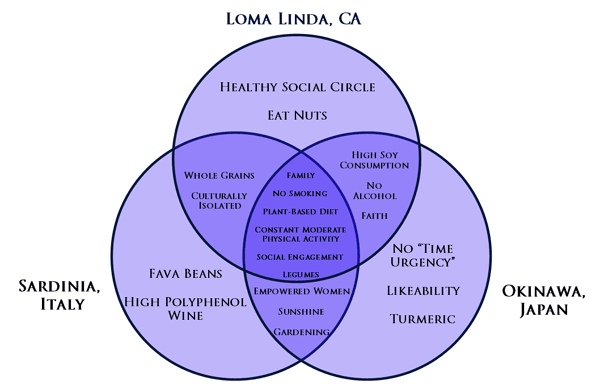
Dan Buettner, in his Blue Zone project, traveled around the world looking for key areas that foster centenarians, people who lived to be 100 or more. He wanted to know what factors contributed to a long life.

Beuttner and his team spent seven years studying four “Blue Zones” where they met people who were aging in an extraordinary way. They interviewed dozens of centenarians, worked with local medical experts, and studied local cultures and lifestyles. Buettner said that each Blue Zone revealed its own recipe for longevity, but many of the fundamental ingredients were the same. Ultimately, he identified nine common lessons of living longer, which he felt were deeply embedded in the cultures they studied.

He found that the Italian island of Sardinia has the highest number of male centenarians in the world; Okinawa, Japan has the longest disability-free life expectancy; and in Loma Linda, Calif., a community of Seventh Day Adventists has a life expectancy that's around ten years more than that of other Americans. What contributes to these long-living elders? Buettner says that first off, they eat a healthy diet and they get “natural” exercise, where physical activity – like walking around the community or climbing up and down hills – is a natural part of their daily lives. 

They remain socially engaged in their communities, whether it be in a village or with a group of strong friends and family in which they are valued. And these centenarians continue to find meaning or purpose in their lives. Buettner describes 104-year-old Giovanni Sannai of Sardinia, saying,

"He was out chopping wood at 9 in the morning…He started his day with a glass of wine and there was a steady parade of people coming by to ask his advice. That's one of the characteristics of the Sardinian Blue Zone — the older you get, the more celebrated you are."

For those of us who don’t live on an island, or in a culture that reveres old age, how will we shape our lives moving forward, to maximize healthy aging? It is not “natural” for older people to disengage with their lives; in fact, contemporary aging research provides evidence of the importance of being involved in activities that inspire interest or passion, whether it be with one’s family and friends, in volunteering to help others, or in any endeavor that creates a sense of purpose and brings older people in contact with others. 

Clearly, one of the hardest things about growing older is loss – loss of friends and partners whom we outlive. In observing my father, I saw that when many of his contemporaries had passed away, he continued to be surrounded by younger people of all ages who were both inspired by him, and revered him as the “elder” in Buffalo’s labor movement and theater community. I believe that this buffered the pain of overwhelming loss, and provided a critical community of friends and colleagues who sustained him for many years. 

How can we create a sense of community – through family and friends, or a social or political group, or an artistic endeavor – that engages us, provides support when needed, and challenges us intellectually?

Aging is not lost youth but a new stage of opportunity and strength.
Betty Friedan

Age is an issue of mind over matter. If you don't mind, it doesn't matter.
Mark Twain

I was always taught to respect my elders and I've now reached the age when I don't have anybody to respect.
George Burns

Tuesday, December 20, 2011

The Eye Serum Saga: A wrinkle in time is ultimately fine…


** As promised, update at the end of the post!

Like many people, I have scaled back on my holiday shopping, instead knitting colorful hats, amidst the usual onslaught of commercialism. On some level, it feels like the relief I’ve always wanted from the burden of the season’s overkill of happy Christmas cheer and frenzied buying. As a Jewish child in a household of quiet tension and heavy depression, I spent many hours escaping into the joy of Christmas on TV. My mother, who struggled with many demons, lit up during the Christmas season. 

Our house was filled with little elves and toy sleighs, and we had a pink – need I say, fake? – Christmas tree, which sat on the mantle next to the Chanukah Menorah. This was to the dismay of my father, an avowed atheist who had been brought up in a strict Orthodox Jewish home. I loved Christmas, and I liked Chanukah. It’s one of the plights many Jews endure. How can Chanukah – a relatively minor holiday for Jews – possibly compete with the glamour and excitement of Christmas?! So perhaps it’s no surprise that the season conjures up a complicated mélange of feelings for me.

This year, as I neared the end of my knitting projects and gift buying, I ventured out to an upscale mall to buy that final present. I timed the visit so I would arrive the moment the mall opened on a Saturday morning, in hopes I could be in and out within a half hour, max. To my delight, the place was empty. I briskly walked by Gucci, Ann Taylor, Coach and Dolce & Gabanna, feeling somewhat smug about being a 99%-er in a 1% mall. I had only two stops to make. At the first, I purchased an item from a weary salesman who was bracing for yet another long day and seemed to appreciate my kindness and empathy. At the second store, I was greeted by a smiling saleswoman who said, ‘wow, you’re movin’ fast!’, helping me to maintain my pace, as she quickly processed my order.


As I was about to step onto the escalator to exit the mall, victorious in my rapid sweep, I heard a woman call out to me. Was it possible that someone knew me in this phalanx of the upper-class? No, it wasn’t anyone I knew; it was a well-heeled salesperson calling out to me from a small cosmetics stand. I turned around a second time, and we made eye contact, and she gestured for me to come over to her. Normally, I resist being roped into buying anything, much less a beauty product, and much less at a mall. But I had managed to not spend much money, and something about her friendly call amidst feeling stressed out in this upscale environment lowered my resistance.

The woman offered me a “simple treatment”. And I thought, why not take a moment for myself, a free moment with no obligations, and then I could sashay out of the mall feeling more relaxed and pampered… She took a calculated and up-close look at me, all the while, spewing a waterfall of words to both compliment me and convince me that I needed to buy a special “eye serum”. She bathed me in what you might call “back-handed compliments” – “you must have been very pretty when you were young, ah yes, you have lovely high cheek bones, and look at your gorgeous eyes! I’d love to see more of them!” I knew it was time to leave, but exhaustion and curiosity kept me there. When she blithely transitioned into the final hook, saying, “I have the product that will make you look much younger”, Mindy #1 said “leave immediately”, and Mindy #2 didn’t budge.

I allowed her to apply an “eye serum” around my eyes – clearly named to imply its scientific nature – while the saleswoman claimed it would reduce my wrinkles, dark circles and puffy eyes. Why didn’t I scream out “NO! I am fine the way I am!”, circles, puffy eyes and all? Mindy #1 knew she was falling for societal messages that glorify youth, and seduce middle-age and older women into spending millions of dollars to appear “young”. But Mindy #2 said that there was no harm in getting a freeby, and wouldn’t it be interesting to see the results of this magic application? Sensing my resistance, the saleswoman assured me that the product was safe and included only “organic ingredients” and “natural herbs”, all the while massaging my face (which felt good!) and telling me I was already looking younger. She worked only on one side of my face, promising me that I would see the difference when she was done.

And then she handed me a mirror and asked me to self-evaluate. Didn’t I see how much less puffy my ONE eye was? Couldn’t I see how the wrinkles had disappeared? Wasn’t my ONE eye looking brighter? Mindy #1 looked very closely and she agreed that one half of her face looked, for the lack of a better word, better... Then the saleswoman pulled out her calculator, as if we were close friends sharing a secret, and sidled up close to me, wordlessly holding it in front of my face to show me the price. You can guess that it wasn’t cheap. Mindy #2 took over, and got incensed. Seeing this reaction, the saleswoman appealed to Mindy #1 and counter-offered, whispering that she would use her special discount card, but no one else could find out. Do you think that the red flags shot up and sirens went off in my head? Yes, but, sadly only in the distance…

Even though I balked at the price, I had momentarily sipped the kool-aid, thinking that I could – or should – look younger through the application of this mysterious eye serum. The next price tag offered was still outrageously high, and the saleswoman got flustered (or should I say, “acted” flustered), moving about in her work area as if she were actually looking for something. Perhaps she was biding time as she thought of her next move, or maybe hoping her behavior would wear me down more. Finally, she stopped fidgeting and offered me an even “more special” discount, and, hooked into the bait, Mindy #1 said “yes”.

When I got home, I googled the product and confirmed that I was one of many, many women who have been bamboozled. The serum could be purchased on-line for about one-tenth the original asking price at the mall, and this so-called natural product was producing an allergic reaction for many of the angry women who “bought” into the youth serum argument… It was only after I realized I had been taken that I reminded myself that I’m fine with who I am, wrinkles and all.

What is aging well? It’s not about botox, eye serums and face lifts, although our consumerist economy would like us to believe that. It’s about eating well, exercising, staying intellectually engaged, and open to new people and ideas. We live in a youth-oriented culture where even young women are getting botox as a preventative measure! It’s time to reclaim our graying hair, our wrinkles and our sagging body parts! To love ourselves as we are…

At the time of this writing, the eye serum saga continues. I have returned to the mall twice to get a refund, but with this so-called “independent” business, only the owner has the “authority” to credit my account, and the owner is avoiding me. Should I camp out at the mall and demand my money back? Should I bring a group of 99%-ers to protest our culture that commodifies youth? Or should I not waste any more time on this foolishness and just accept that I lost some money? If nothing else, this experience has reminded me that I am not impervious to our youth-obsessed culture and am vulnerable to persuasion. Good information for the next time…

** When I first posted this piece, I said "stay tuned and check back at this site. I’ll let you know how the situation resolves (e.g., get my money back, have a raging argument with the owner, start an anti-anti-wrinkle campaign for older women!)…"

After two days of not getting a promised call-back from the owner, he finally called me this morning and said to come back to the mall for my refund. And lo and behold, I got it!  THE END!  
P.S. This was only part of the battle won. I still may start an anti-anti-wrinkle campaign!

Tuesday, October 18, 2011

Surviving downsizing...


There’s a lot of attention in the media on job loss and unemployment these days, but very little attention is being paid to the people who “survive” downsizing, the workers who remain on the job after a lay-off. Over the years, I’ve done numerous studies in corporate America, focused on family policies in the workplace. In some cases, massive layoffs were taking place as I was conducting my research. I was even hired by one company to find out why people were leaving their jobs, and then they laid off thousands of workers.

Life before, during and after a lay-off is no picnic. Researcher Joel Brockner says that workers who survive downsizing are likely to experience more stress and less organizational commitment and motivation. In fact, while victims of downsizing lose their jobs, survivors of downsizing experience a loss of control over their jobs. They worry they might be next, and that feeling of uncertainty permeates the entire work environment.

In one study, I investigated the impact of flexible work policies in six large corporations. Five had significant “reductions in force” during the course of the study. In effect, I ended up studying the family policies in the context of downsizing, as it affected the remaining workers and the organization.


Brockner says that corporations can mitigate the negative reactions from survivors of downsizing, particularly if they are perceived as operating fairly, in terms of the criteria or procedures they use to lay off their workers (1995). Other researchers say that companies can avoid the wrath of their surviving employees if they subsequently create employee empowerment and job enrichment initiatives after the layoffs (Niehoff, Moorman, Blakely and Fuller, 2001; Spreitzer and Mishra, 2002). But in my experience, companies are very inconsistent about what the provide for workers after a major downsizing. Some make an effort to maintain the morale of the “survivors; and others tighten up and demand more from their workers.

Tension in the workplace
After a lay-off, the surviving workers are often burdened with doing the same amount of work with fewer workers. Moreover, opportunities for advancement are curtailed, which creates increased competition among the survivors for any opportunities that do arise. What develops is a “mentality of scarcity”, which produces more tension in the work environment, and more competition for special assignments. One worker told me:

"What I find is that my coworkers don’t share information as freely as they used to. They’re just more protective about information. I don’t feel like I can trust them like I used to. It’s because people are scared. Their future is up in the air, and there are no positions, so people get kind of competitive and kind of closed".

In one company, I observed that this tension was also a set-up to exacerbate tensions around race, gender and work life issues. A substantial percentage of white males reported that they had experienced reverse discrimination, saying that they felt they had been passed over for jobs that were filled by women or African-Americans. Some even complained that mothers were given preferences for certain job assignments over them. These kinds of biases – likely unexpressed in the best of times – are more likely to manifest in subtle ways when there is economic stress. Because people don't tend to express these negative feelings openly, where they could possibly be addressed (possibly...), they fester silently and affect the workplace climate.

Moreover, in a downsizing environment, people are afraid to speak out about problems in the workplace. Self-censorship is more likely; dissonance is less likely, and innovation may be discouraged.

Trust in senior management broken down
Some of the workers I have interviewed said they perceived downsizing as a breach of the psychological contract between the employer and employee, hoping – and perhaps expecting – that they had job security and opportunities for development. According to researchers Morrison and Robinson (1997), this belief that a psychological contract has been breached can lead to feelings of injustice, deception or betrayal among employees.

In some cases, I found that prior to a lay-off, companies doled out information irregularly, promising there wouldn’t be lay-offs or buy-outs. Some employees described an elaborate process of how they found out about an impending lay-off. First they heard the promise that nothing would happen, then the “news” that there would be lay-offs, but with no date, and then a manager would post a new organizational chart, with no details. That would be followed by a promise of more information. Later they were given some criteria for who would be laid off, with no names. At that point, people would be scrambling to figure out if they were on the list. Finally, after all of this time, some workers were given the news, and told they had to leave in a couple of weeks, or maybe a month or two.

In one department of a company that had major lay-offs, nearly every employee I interviewed “confessed” that he or she was taking Prozac and seeing a psychiatrist. None of them were talking to one another about how they felt. In another company, workers found out about a major downsizing through a video from the company president, which they all had to watch simultaneously. You can imagine the morale of the workers, including those who lost their jobs and those who would remain. Another company pulled all of its middle managers into a special, private meeting, and they had to sit with the information for many months before they could share it with their colleagues. One worker told me:

”With all these policy changes that are being made, people just feel like something big is coming. Even if they say it’s not going to happen, nobody believes them anymore.”

The job lost its meaning
For some survivors, the loss of co-workers and their fear of losing their own jobs is only part of the picture. Downsizing affects how work is done, and impacts individuals and teams. Often the work itself feels less meaningful, as workers recognize that they have less control over the product and the process. One worker told me:

“The entire process feels like paper pushing now. People feel like they’re just going through the motions instead of doing a quality job. The job satisfaction is just not there. People do not feel challenged. They just do not feel like they’re making a difference anymore.”

Jobs Policy
As politicians battle over the best way to stimulate the economy, the priority of creating new jobs is imperative. We need to generate revenue to pay for new jobs, and I would suggest that the first place to start is creating a fair and equitable tax policy, in which the weathliest of Americans and corporations pay their fair share. Our political leadership should be looking back at the New Deal for how to create an interim jobs program; and forward to create a solid infrastructure that produces jobs that are well-paid and secure. Our government needs to increase incentives to the private sector to build jobs at home, rather than in search of cheaper labor elsewhere around the globe. And if we are to reduce poverty, we need to ensure that our education system and the social safety net are fully funded. 

Listen to Senator Bernie Sanders’ perspective on a progressive jobs policy:


Friday, May 20, 2011

Sex and the City for older celebrity men...

The past couple of days, we’ve been fed a double media dose of celebrity men who were outed for their sexual “indiscretions”. 

Gerontologists would describe both men as “young” old. Arnold Schwartzenegger is 63 and Dominique Strauss-Kahn (DSK) is around 62. Interestingly, they are both married to successful women, and both sought out women with lesser social status, in the context of our racially and economically stratified society.

You might say, ‘who cares’ about what these dudes do with their sorry lives?! It’s just more fodder for infotainment, distracting us from real news, like efforts to make progress in the Middle East, the movement to save collective bargaining around the country, and the debate around the Paul Ryan budget plan, just to name a few examples of real news.

But there is something that grabs me, as I see the media go wild about two older men of means who pursued sex with young working class women of color. Did they think no one would find out? Were they so insecure about themselves that they sought to boost their self-esteem with sexual conquest? Were they so (falsely) secure that they believed they could do anything with and to anyone? What was Schwartzenegger thinking when he fathered two children at roughly the same time right in the same home, with different women? Did DSK think that the maid really was attracted to him (i.e., yes means no)? We’ll never know…

But we can look more broadly at the norms within our culture that promote and privilege male sexuality. We can explore societal values that support some men’s belief in their right to sex, even when it’s outside of marriage or even illegal. Does age factor into this equation? Yes. We generally view older men and women as less sexually potent, less attractive, less “available”. This notion is reinforced by a pervasive youth culture that surrounds us, which is hard not to internalize. By stepping over or around the sexual norms – whether through an affair or a sexual assault – these older men can affirm that they are, in fact, virile and therefore, still “real men”.

Gladly, in both cases, the media has not proclaimed “boys will be boys”. Instead, it is focusing on embracing two whole-sale opportunities to fire up some scintillating news and keep us wanting more. (Suddenly, Bin Laden is moving to the second page of the news, and Paul Ryan’s budget plan seems – well – less sexy.)

Perhaps we should view this media blast as an opportunity to better understand the relationships between gender, power, age and sexuality…