Search This Blog

Monday, January 31, 2011

The kindness of strangers...


This past weekend, I visit my nearly 100-year-old dad who is now in home hospice in an assisted living facility. With several major organs failing, he remains the perennial survivor. As a literary guy, he always used to quote Dylan Thomas, saying: "Do not go gentle into that good night." And he continues to hold on...

I leave his apartment after my visit, feeling both a sense of relief as well as a deep sadness, even though I know I will see him in two weeks (assuming...), and that meanwhile, he is being well-cared for. As anyone who has taken care of an older person knows, caregiving is stressful, and caregiving from afar has its special stresses.

The ride to the airport is straightforward in this small city. It's always a bit nostalgic as I pass by my father's old house, where he continued to live alone up until two years ago, when we moved him into assisted living. As I pass the old street, I call my husband to let him know my plane is delayed, ignoring the state's anti-cell phone law. (Okay - I know it's unsafe, but I was at a stoplight!). And then it happens - BOOM! 

I feel my car being hit from behind. I say matter-of-factly, 'Oh my G-d, I was hit. I've got to go.' And then my car gets hit again! I manage to move into the next lane, and this car keeps charging forward, hitting the car that was in front of me.

I jump out of the car, realizing that I'm okay, but see that my rental car is not. The driver responsible for all this reckless bumper car action is an older man, probably in his 80s. I tell him to pull over and then follow him. Turns out that he had put his foot on the accelerator instead of the brake! He claims that his foot was stuck. He is on his way to visit his wife's grave. She had died six years ago, and he has borrowed his son's car to get there.

The front bumper on his car is mottled, but aside from being stunned, he isn't injured. Of course, what happens with him and his son is their next chapter, not mine, and I can only imagine. (Will the man continue to drive? With the son lend him his car? I hope not...) With this crash, we are connected by our humanness - this elderly man who is grieving for the loss of his wife, and I, who am grieving for the gradual loss of my father.

But there isn't time to meander. My flight is leaving soon. I get advice from the rental car company about information I need from this guy, and after well wishes, I move on, driving down the highway, with half of the bumper hanging off my rental car.

As I enter the airport roadway, I call the rental car company. Like relay racers, they are ready and waiting, as papers fly between us and I gather my luggage. Running to the ticket counter, I arrive out of breath, only to be told that boarding for my plane is closed, and it's too late to get on the flight. I plead for the airline worker to do something, sputtering fragmented sentences about my dying father and my accident. Just an instinct to use a sad story to manipulate authority... And then out-of-the-blue, another kind airline worker intervenes and calls the gate and tells them to hold the flight for me. Just for ME!

They tell me to HURRY to the gate! I get through security as quickly as one can get through security, run up to the gate, heart beating wildly, and apologize to the airline worker for holding up the flight. She looks at me whimsically, and says with humor, "Oh yeah, the whole flight is waiting just for you!" It turns out that they have not even started to board the plane. In fact, I have about 20 more minutes to wait. With that relief, I blurt out my story again, and this time, start to cry. For a moment, she looks me straight in the eye, and then she wraps her arms around me, saying, "I'm such a softy. I feel like crying with you!" And we do. Me and an airline employee! 

Today, the airline gave me a $50 credit for the "inconvenience you recently experienced with us." So thank you, Jet Blue worker and thank you, Jet Blue.

But most of all, I am grateful that in the midst of the challenges of caregiving, I have encountered people - strangers - with whom I connect, who gracefully help to diffuse those challenges.

Friday, January 21, 2011

Progressive family policies that are close to home...

A number of years ago, I was invited to the Pentagon to talk about a work and family study I was conducting. Anyone who knows me may find this fact pretty incongruous. But I was intrigued to find out about the human resources side of the military. Given my history of antiwar and women's rights activities - and the fact that my father had been subpoenaed to appear before the House Un-American Activities Committee in the 1950s - I fully imagined that I wouldn't make it through the security screening. But, to my surprise, I sailed through. I found myself being chaperoned through dingy hallways to a very nondescript office for a meeting with a powerhouse of a woman who headed up programming on family supports for military "members" and their families.


Over the next two years, I worked with her and a real live Colonel, a kind and gentle soul who was an expert on domestic violence issues in the military. Our work together focused on assessing how well various military family support agencies were able to collaborate. Their "mission" was to support families through the challenges of dealing with deployment and loss.


I initially felt like a fish out of water working within this institution. But I soon connected with the human dimension and discovered that within the military, there are people from incredibly diverse backgrounds - including political perspectives - who really care about people's well-being. I also learned that the military has far more progressive family policies than governmental policies in the civilian sphere, which rely on a hodgepodge of precarious private and public funding to service those in need.


I discovered, for example, that the military provides high-quality, affordable and accessible childcare in which early childhood teachers are paid good wages. According to Gail Zelman and Susan Gates, researchers at RAND,


"While there are no easy or obvious solutions to the childcare problem, policymakers can look to an unlikely source from ideas about improving childcare: the military. The US Department of Defense (DoD) has succeeded in optimizing the three key aspects of child care delivery - availability, quality and affordability - a juggling act unduplicated anywhere else in the country. The system currently meets around 60% of the assessed need, serving about 176,000 children 6 weeks to 12 years old in 900 centers and in 9,200 family child care homes nationwide. (Family child care homes are usually run by military spouses.)"

Let's be honest here:  The military's desire for high levels of productivity and commitment among its members - and the need for support from military family members - are the drivers underpinning military support for these policies.


So what can policymakers learn from DoD's experience, ask researchers Zellman and Gates?


"The clear message is that affordable, high-quality child care requires a system level commitment to quality, as well as incentives and funding to make it a reality."


In contrast, our "civilian" child care system in the U.S. is underfunded and suffers from lack of quality, which can largely be attributed to low wages and inadequate support for its workers. In fact, the turnover rate of early childhood teachers in the U.S. is between 25-30%. Research points to a "turnover climate" which affects overall program quality. One study found that highly trained teachers (BA level or higher with specialized training) "were more likely to leave their jobs if they earned lower wages, worked with fewer highly trained teachers and worked in a climate with less stability." (Whitebook, at al, 2001). Therefore, worker retention is linked to the stability of the program and ultimately, to higher quality.


In addition to high quality, affordable child care, the military offers paid parental leave and universal health care. Ironically, when progressives promote these policies at the federal (civilian) level, conservatives cry 'socialism!'


In a memo entitled, "For Our Air Force Family," Lieutenant General, USAF, Assistant Vice Chief of Staff, Joseph H. Wehrle, Jr., says,


"The United States Air Force is committed to taking care of its own. Steadfast, homefront support is provided to family members by the Integrated Delivery System... As always, we remain One Force, One Family."


in the military, the credo - "We take care of our own." - is motivated by the belief that this will support "readiness" for battle, increase productivity, reduce turnover, and ease the process of leaving one's family behind to put oneself "in harms way" around the globe.


Without such immediate drivers in the corporate or non-military governmental sphere, it is hard to make the case - or as human resource professionals would say, the business case - for progressive family policies. But we don't have to only look to Europe for inspiration around family policies; we can look to the U.S. military to find some of the most progressive policies in this nation. Don't we all deserve them?

Tuesday, January 4, 2011

Knitting through the storm...


My grandmother survived the pogroms of Eastern Europe, a solo journey to America at age 13, and my grandfather, who is one of the grumpiest men I've ever met. But until the day she died, just shy of 100 years old, she was an avid knitter, spewing out afghans, sweaters and socks to keep her brood of nine children clothed and warm. Lucky me received one of her gems at age 20, a very tidy little blue cardigan that I have to this day.

I never really thought of my grandmother when I started to knit. It just seemed like a fun thing to do with my daughter, with whom I used to "co-knit" scarves that were more about process than product.


Several months ago, a friend, whom I will call my "knitting guru", pulled together a group of women to knit caps for a special neighbor friend who was going through chemo. I was driven by the mission and inspired by the camaraderie of the group, and managed to make several hats for our friend. They were full of flaws, but beautiful, nonetheless (if I do say so myself!). We all read Kyoko Mori's book, "Yarn: Remembering the Way Home", a memoir that is framed by lessons she learned from her knitting experience. I was most touched by her recognition that mistakes are okay. I realize that this sounds pretty basic! But somehow knitting lends itself to metaphors that speak to the heart. For example, 


* Individual pieces of yarn weave together and create something beautiful and new.
* Sometimes, when you make too many mistakes, you just need to undo what you've done and start over.
* When a ball of yarn gets really knotted, it takes a long time to undo the knots.

See what I mean? Once I got the knitting bug, I discovered a world of knitting addicts (we are everywhere!) who find pleasure - as do I - in color and texture, and creating usable objects that people want to wear! What a concept! I also discovered that the process of knitting is meditative, relaxing, invigorating, all-consuming, jitter-reducing, anxiety-protecting, and creative. Once you've gotten past stage one, you can actually talk and knit, which is also incredibly satisfying...


When I told my college-age daughter I had started to knit again, she expressed concern that I was - in short - getting old. Despite my arguments that knitting was the "new cool", she had conjured up images of me as a doddering old grandmother, content with my yarn and needles. Alas, when she saw the hats I was making, she put in a request for a sweater, and lo and behold, she started to knit too!


My first three hats went to my friend who had lost her hair. The next three were sold to neighbors during an "open studio" event, in which people stroll through the 'hood and view art on display in and around people's homes. These folks actually paid money for my hats! The next batch went to my family. My father - nearly 100 years old - had moved to assisted living and I had started flying to visit him every other weekend. 

I made four hats for the cousins who house me when I'm visiting him. They call them their "Mindy's." I've made five hats for my immediate family, including my husband and sister. And I finally made a hat for my father, who, after seeing all this knitting action, said he'd like "a Mindy" for himself. I also made several hats for my daughter's friends and a neighbor. The next few hats will be for the amazing people who care for my father nearly 24/7, keeping him alive with their love and attention.


When I think I'm done making hats - after all, there are a lot of other interesting things to make - someone else puts in an order. And I'm grateful for it...


Sunday, December 19, 2010

Bad bosses...


We've all had them, and maybe some of us are them! (No, not us!) As a sociologist who has spent many years studying workplaces, I am indebted to a number of bad bosses. Although some of them made my life miserable, they inspired me to understand why. So in the spirit of acknowledgment, I must first say thank you to the boss who told me I was destroying my life by leaving the job to pursue another direction. (Destroying whose life?) And thank you, too, to the psychotic boss who knew that I supported a particular political cause, and out of nowhere screamed at me, "Don't ever let me see you on television with a sign in your hands supporting that Communist (crap)." Whoa! It hadn't occurred to me, but now that you mention it...And thank you to the newly appointed manager who, in her first month on the job, falsely accused me of serious financial improprieties. (One month, and many sleepless nights later, I was vindicated.)

Given these experiences, it has been therapeutic to study the American workplace and to dissect some of the problems that contribute to "bad-bossism." Despite having been "stung" by a few bad bosses, I still believe that people - including some bad bosses - are basically good.

So what is it that leads some people in management positions to "behave badly?" Well for a start, the workplace is a microcosm of our larger culture and society. Societal problems that exist outside the office are likely to surface within it as well, playing out via power dynamics between and among employees, based on their occupational status, their gender, and their racial and ethnic backgrounds.

Political economist and philosopher, Karl Marx, laid the groundwork for understanding the intrinsic tension between labor and management (or, as he would say, capital), in which a capitalist system favors profit over people. In this system, he argued, management would necessarily exploit workers with long hours and poor working conditions, in order to get more productivity out of workers, which in turn would maximize profit. With the advent of laws that limit working hours in manufacturing settings, and the regulation of working conditions, Marx's critique and analysis continues to provide a useful framework, even though it's probably more relevant to manufacturing work in Third World countries, where many multinational corporations have moved their operations in search of cheaper labor.

In the U.S., our current economy has increasingly shifted to knowledge-based work and services, and the lines that are drawn between workers and managers are often painted as more subtle. Nonetheless, stratification of the labor force ripples through multiple levels of professional and managerial workers. How do these dynamics affect the contemporary workplace?

Studies suggest that a number of factors shaping workplace environments contribute to the "bad boss" phenomenon:

1. Male model of the ideal worker
In this model, the "normal" trajectory of the worker is based on a "male model" of the ideal worker, a person who can work throughout his (her?) career in a continuous and uninterrupted manner, taking no time for non-work (e.g., personal, family) activities. Sociologist Erin Kelly, et al calls it a "masculinist work culture", commenting,


"Working long hours is a sign that employees are readily available and eager to meet others' needs; it further reinforces the ideal worker as someone - most often a man - who does not have, or does not attend to, other pressing commitments outside of work."


With this model, work comes first. When managers perceive that's not the case for one or more employees, it's viewed as an affront to the company, a deviation from employee loyalty. Managers who "buy into" a "masculinist work culture" are likely to be critical of workers who challenge this norm. In a study I conducted on parental leave policy in a large financial services company, the norm was so powerful that men chose not to use the company's generous parental leave policy, and women who used the policy took very short leaves, even though legally, all employees were entitled to longer leaves.


2. Structural issues that create a culture of competition
in our current American workplace, where the bottom line rules, there are economic pressures to produce. In line with the prevailing capitalist ethic, a culture of competition is viewed by many managers as necessary to foster productivity, with long hours as the norm. In order to sustain productivity, managers feel pressure from above to push employees to produce more, even when they realize that it's not humanly possible. In a number of the workplace studies I've conducted, I've learned that being in a middle managerial position is often isolating. This makes these managers depressed and grumpy. Most have little support to figure out a better way, and they realize quickly that too much empathy for their "subordinates" takes too much time. Ergo, they may "act badly."


3. Poor economic times makes managers even more grumpy
In our crisis economy, the financial pressure is even more intense, and some managers may exhibit more controlling behavior towards their employees. Managers are being more closely monitored on financial performance, and they may be even less likely to take the time to attend to employees' feelings or needs under these conditions.

4. "Deal with it; I did!"
Some managers worked hard to get where they are, and along the way, they experienced a lot of pain themselves. When they get to the top (or close to it), some pass on what is familiar. While many of the managers I've interviewed worked very hard to respond to the needs of those under their supervision, some were less than understanding.

5. Lack of management training
Some managers who are good workers are rewarded by being moved up to management positions. While some organizations prepare their workers for this type of promotion, others fail to prepare them for the pressures they encounter once they are in charge. Without adequate management training, some bosses make mistakes, even lots of mistakes. Sometimes they find themselves in positions of power and it feels uncomfortable. They're being asked to do things with and to workers that they wouldn't have liked themselves. They know that. But they don't know how to challenge or work with the system without jeopardizing their reputation or losing their jobs. This can make for frustration and grumpiness.

6. Personality problems
Some managers just shouldn't be managing people. Their "management style" may look good to upper-level managers because it fits in with a culture of competition and drive. But they may be making the people who work for them miserable. Because of an "us" and "them" dichotomy, other managers may even side with them.


Perhaps we all have a story about the crazy or mean or incompetent boss. Are all managers bad bosses? No, of course not. But the problem is clearly pervasive: Google "bad boss" and you'll find over 7 million citations, with countless workers publicly venting about their negative experiences, and experts offering advice on how to deal with that mean and disrespectful supervisor.


What is a good boss? There's plenty written about good bosses as well. Google "good boss" and you'll find over 14 million citations! Hopefully we've also had them (and maybe even are them!).


Here's an excerpt (slightly tweaked) from an 10/10/10 article in the Chicago Tribute by Mary Schmich about what makes a "good boss."


* A good boss understands that all power is fleeting and borrowed, and doesn't take advantage of this moment.
* A good boss realizes that her/his real power comes not from those above him, but from the rank-and-file.
* A good boss listens, and can see a problem before it turns into a crisis. If it does turn into a crisis, the good boss works with an employee to resolve the situation.
* A good boss understands that your time is important too.
* A good boss is a good communicator, responding to your concerns and questions in person and via electronic communications.
* A good boss treats employees with respect. S/he does not treat people differently based on their occupational status, gender, race or sexual orientation.
* A good boss tries to make everyone feel special and included.
* A good boss is self-aware and tries to understand how his/her behavior affects others.
* A good boss has the courage to deal with problem employees, and does it professionally.
* A good boss tells you when you screwed up and forgives you.
* A good boss does not take credit for your ideas, nor does s/he demand credit when s/he gives you an idea.
* A good boss is not afraid of people as smart as s/he is.
* A good boss sees what you do best, matches your job to your talents, and gives you room to bloom.
* A good boss remembers how s/he felt about bosses before s/he was one.
* A good boss reveals just enough about her/his personal life to remind you that bosses are people too.
* A good boss doesn't take bonuses when the workers can't get a raise.

* A good boss knows how to apologize and how to laugh, sometimes at him/herself.
* And a good boss understands how much we all yearn for a good boss.

Wednesday, December 8, 2010

Telecommuting: It's about time and place...

I just wrote the following piece for WorkplaceFlexibility.com.au, based in Australia. Thanks to Juliet Bourke from Aequus Partners for allowing reproduction:

After considerable debate, the U.S. Congress has finally approved the Telework Enhancement Act of 2010. 

The Bill, which has passed both the House and the Senate, is now awaiting President Obama's signature. Once that happens, federal agencies will be required to develop a policy that allows eligible employees to do at least some portion of their work outside of the office, with the aid of electronic communications. Agencies will also be required to incorporate this alternative arrangement into its operational planning for natural and other disasters.

Why it's a no-brainer...
There is an abundance of research data demonstrating the positive effects of teleworking - or telecommuting - on employee well-being and on the employer's bottom line. In a "meta-analysis" of 46 studies of telecommuting involving 12,833 employees, Pennsylvania State University psychologists, Ravi Gajendran and David A. Harrison, found that telecommuting was a win-win for both employees and employers. 

Telecommuting gives employees a sense of freedom at work, which contributes to job satisfaction. It reduces stress and helps workers balance their work and personal responsibilities. Employees who telecommute maintain and increase their productivity. Having access to telecommuting increases workers' loyalty; and working outside of the office for one or two days per week has no negative effect on employee relations with coworkers or managers. 

Gejendran and Harrison's findings reflect what I learned in a small qualitative study of women telecommuters who were employed in several major American corporations. Despite the dramatic influx of women into the paid labor force in the past few decades, they continue to be the primary caregivers within their families. With inadequate government family policies in the U.S., and the limited response within the private sector to employees' family concerns, our society is experiencing an enormous care gap. Telecommuting provides women - and increasingly men - with a legitimate avenue to combine and/or accommodate their market work and caregiving responsibilities. 

The women telecommuters I interviewed claimed that the arrangement improved their work-life balance, allowing them to have more control over when and where they performed their work. At the same time, telecommuting helped them to maximize their productivity, serving the ultimate objective of employers. One telecommuter I interviewed for the study told me that she was able to maintain her work, despite dealing with a serious health problem.

"I've just been diagnosed with breast cancer, so about a month ago I had surgery and now I'm getting radiation every day, and in the summer I will start chemotherapy. So being a telecommuter is enabling me to work from home if I'm not well enough to come into the office."

And a manager of a customer service department told me that telecommuting, while supporting employees' needs, also benefited the company's bottom line. Describing his rationale for implementing a telecommuting policy in his department, he said, 

"People can do the same thing they can do in the office at home and save them the wear and tear of coming to work, the wear and tear of a long commute in many instances, maybe tolls... schlepping around with the kids trying to go to a child development center. The company benefits to the extent that every time we have a bad weather close-down, we have people on the phone at home instead of disruption of service. So it's a win-win on both sides."

Trial run in the States...
Indeed, telecommuting has been instituted in a number of U.S. federal agencies already, as well as in numerous corporations. In a 2004 study of 74 federal agencies, 43% of employees (323,292) reported that they were eligible to telework, compared to 35% of employees (625,313) in 2002, representing a gain of more than 20%. And in the overall U.S. labor force - including public and private employers - it's estimated that more than 33.7 million workers telework at least one day per month.


Moreover, 22 states have already passed telework legislation. A number have implemented these policies to address environmental concerns or traffic congestion; some states encourage private employers to implement telecommuting programs; and others have statutes connecting employee productivity and efficiency to telecommuting, or promoting "a better quality of life."

Historically, many federal policies in the U.S. are first implemented at the state level. This was the case for Social Security, health care reform, maternity and parental leave, and even civil rights legislation. The federal legislation was the culmination of pressure in smaller policy environments. But having a federal bill can also provide a model for more universal implementation. In addition to creating a mandate for federal agencies, hopefully the Telework Enhancement Act of 2010 will provide encouragement for additional states and private sector employers to institute or expand their telecommuting policies.

Making the Bill real...
While the effects of telecommuting are positive for employers and employees, it is only workable for certain types of work and with certain employees, and therefore not a universal solution to problems in workplace policy. But it is particularly well-suited for those doing "knowledge work" that can be effectively performed in multiple locations with the help of electronic communications. 

Even for those who have jobs that are conducive to telecommuting, the face-time culture of most organizations may undercut its utilization. It's one thing to have a policy, and yet another to have employees use it. The Telework Enhancement Act of 2010 requires training for employers and employees, which is a critical element to shift an organization's culture. 

In my telecommuting study, I found that even those who felt supported for their work at home felt it was a privilege, and in turn, worked additional hours to "prove" their loyalty. But when they did use a policy, it improved their quality of life.

The cost/benefit debate...
The sad fact is that Republican opposition to the Telework Enhancement Act of 2010 is not based on what's good for employees or employers. It simply affords Republicans another opportunity to say that less government is better. But that argument doesn't make sense if the policy is administered with care. Representative Virginia Foxx, a Republican legislator from North Carolina, argued that with a high unemployment rate, it is a "travesty" that Democrats are "pushing this initiative to make it easier for federal employees - who already have it much easier than the rest of the country -  to avoid the office."

 
Rep. Darrell Issa, a Republican legislator from California, said that the law adds a layer of bureaucracy into federal agencies, claiming that Americans want less government. Bolstered by recent elections of conservative Republicans to Congress, he says, "This will be the first vote after the American people said no to government waste, fraud and abuse, government growth and government spending." Issa will undoubtedly try to amend or change this legislation when he begins his role as the new Chair of the House Oversight and Government Reform Committee. According to the New York Times, Issa's plans are part of a larger Republican agenda to vastly expand scrutiny of the Obama administration and aggressively push to cut spending and shrink the government, focusing on "excesses and waste."


Democrats who supported the passage of the telework legislation provided evidence regarding its cost-effectiveness. The Congressional Budget Office estimates that implementing the bill will cost around $30 million over five years, but the return on this investment will pay off over time. Representative Stephen Lynch, a Democratic legislator from Massachusetts and my very own Congressional representative, said the long-term savings will provide an "excellent return" on this initial investment. And indeed, the experience of many private companies suggest that he's right on the money. IBM has saved as much as $56 million annually and reduced office space by allowing employees to telework; Cisco generated an estimated annual savings of $277 million in productivity by allowing employees to telecommute. And IBM Canada currently saves $20 million in operating costs annually and over 500,000 feet of real estate with its telework program.

Let's hope that sanity - backed up by plenty of data and experience throughout the U.S. - will prevail once this sensible piece of legislation is signed by the President, and that the resistance will be met with reason.

Saturday, November 20, 2010

"Good parenting" in an age of work-family imbalance...


Yesterday, I shared a long plane ride with a Japanese woman who was coming to the States to visit a friend. She patiently helped me try to track down an old Japanese friend via Google. Yes, there was WiFi on board; yes, Google in Japanese is very cool; and no, we were not successful in tracking her down! But more importantly, we talked about work and family issues, as she described the gendered division of labor in Japan. She is employed as a translator, but took a 10 year hiatus from her paid work - actually quit her job - to care for her son. This is typical, she said, among women "in her generation." (After our conversation I calculated her age as around 43.)

In his book, The New Paradox for Japanese Women: Greater Choice, Greater inequality, Japanese economist Toshiaki Tachibanaki presents a gendered analysis of the Japanese economy. He reports that while Japanese women now have more choices in their careers than in earlier days when their education consisted of preparing them to be "good wives," they now face job discrimination, sexual harassment and wage inequalities on the job. My new Japanese airplane friend commented that her husband wanted her to stay home with her son, telling her that it was the most important thing she could do. He, on the other hand, was working 12+ hour days. When I asked her if he was "able to" spend time "at home," she winced and said that he did play with their son sometimes, but didn't do any housework or cooking.

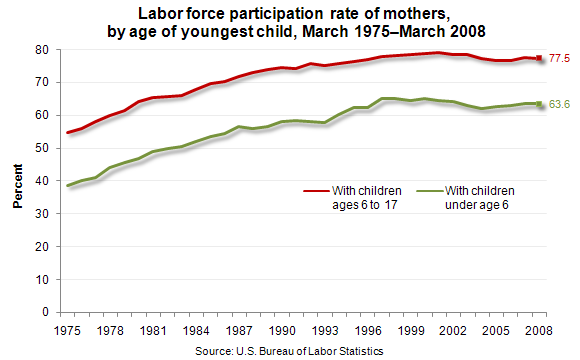
She was surprised to hear that over 75% of American mothers of school-age children work for pay. In Japan, nearly half of all women work in the labor force, but Japanese women earn less than half of what men earn. So it's no surprise that women take on the brunt of the caregiving responsibilities, simply from an economic perspective. By the way, the gender wage gap in the US also is a significant problem, particularly for mothers, albeit less stark than in Japan.

She also described the dissolution of the extended family in which multiple generations lived together. Without a grandparent to do childcare, women in Japan have a harder time sustaining full time employment.

While we didn't dive into a discussion of childcare policy in Japan, her observation got me thinking about the meaning of community and the gendered division of labor during my childhood years in the 50s. The 1950s in the U.S. are portrayed much like my Japanese friend's description of contemporary Japanese culture, with the general assumption that mothers' most important work was to stay at home with their children. 

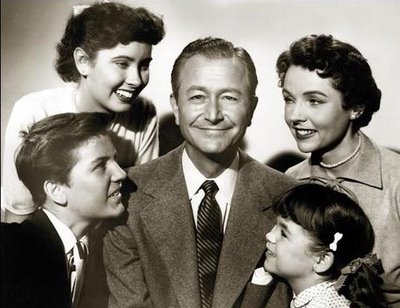
But what did staying at home actually mean in 1950s America? I know from personal experience, as a child of the 50s, I spent hours playing on the street with my friends. Whether it was kickball, dodgeball, relay or two-person races, or making up plays, we kept each other busy (on the street, as opposed to off the streets!). When I wasn't in school or hanging out with my buddies on the street, I was taking dance classes or piano lessons. And when I wasn't in school, on the street or at a lesson, I was firmly planted in front of our black-and-white TV, watching "traditional family life" in shows like Leave it to Beaver, Father Knows Best, and Ozzie and Harriet. While my mother was a "stay-at-home" mom, like the majority of middle-class mothers in that era, she and I didn't spend a whole lot of time together because, frankly, I had other fish to fry!


Despite the glorification of family life in 1950s America, believe it or not, mothers today spend about the SAME amount of time as the 50s and 60s moms who did not work outside of the home! Family sociologist Suzanne Bianchi found that while the number of children with mothers in the paid labor force has gone up considerably between 1965 and 2000, there has actually been a slight INCREASE in the amount of time moms are spending with their children over these years now - from 10.6 hours per week in 1965 to 12.9 hours per week in 2000. Contemporary dads also spend a little more time with their kids these days, from 2.6 hours per week in 1965 to 6.5 hours per week in 2000.


So what's the deal? Well it looks like a number of factors have converged to create this new reality, even though mothers and fathers spend a lot of time at their paid jobs. First of all, the work of the "at-home" mother has been greatly altered by technology and fast food. Meal preparation - especially when it comes from a takeout joint, comes out of a package, or pops out of the microwave oven - takes less time. Mothers are also spending less time cleaning the house, compared to a few decades ago. Dust bunnies prevail! And actually, fathers never spent a whole lot of time cleaning the house anyway, so no big change there.

But equally important, the notion of good parenting has shifted over the years from more hands-off to more intensive, involved parenting. From playing classical music to your in-utero fetus to knowing all your kids' teachers to coaching her Little League team to texting daily with college age kids, the contemporary notion of "good parenting" has been redefined as engaged parenting. Based on the research, it seems that mothers who work outside the home want to "protect" the amount of time they have with their children; ergo, spend as much time with them as possible. 

In her study of nurses who work night shifts, Anita Garey found these women chose night hours so they could maintain the notion of the "ideal mother" who was available to meet during the day with her child's teachers, bake for the bake sales, and show up at school events. All this came at a cost: sleep and personal care. Sociologist Arlie Hochschild called this phenomenon the "time famine." Bianchi argues that the increase of mothers in the paid labor force, at least in two-parent families, has shifted some of the caregiving responsibility to fathers, commenting,


"Perhaps most controversial, women's reallocation of their time probably has changed men. The increase in women's market work has facilitated the increase in women's involvement in child-rearing, at least within marriage."

Clearly, the economy is the driver in the U.S. and other parts of the world, creating an imperative for women to participate in the paid labor force. But women, like men, derive meaning from paid work, and the women's movement of the 1970s - while rarely mentioned these days - had a powerful impact on women's sense of entitlement in the workforce. 

While we are not battling the level of tradition that exists within Japanese culture, we have a long way to go to achieve equity, particularly for mothers in the paid labor force.

To achieve real equity in the labor force, we need concrete changes in government policies that promote and protect wage equity for women, and protect against gender- and parent-based job discrimination. We need a paid parental leave policy, and support for shorter work hours so that parents of young children can choose to gradually return to full employment after taking a parental leave from the jobs. We need universal child care so that all young children have access to high-quality early education and care, and not just those in families that can afford it. And we need universal health care, so that workers are not reliant on a job for their health insurance. That's too dangerous in this economic climate, and even with employer-based insurance, there is too much variability in the type of care provided.


Tall order? Maybe, but we need a comprehensive set of solutions to achieve "good parenting" in this age of work-family imbalance.


Tuesday, November 2, 2010

Living in assisted living...

When I first visited my father's assisted living facility, some guy shuffled up to me and asked, "Am I going to dinner or lunch?" I managed to reply as if it were the most normal question in the world, but felt like I had landed in the Twilight Zone. Over the past year, I've grown accustomed to hearing just about anything that anyone says. For example, over dinner this guy I really like, Harry, whispers to me in a conspiratorial tone, "How old is your father?" I tell him, for the umpteenth billion time, that he is 97-years-old. And as if this is the first time he's heard this news, he responds with shock, telling me that my father looks so young! Harry tells me he's 90 and then turns to his girlfriend, Millie, who is only 80, and says, "Isn't that right?" She replies patiently, "Yes."

Lately, I've been spending a lot of weekends with my father, as his health is rapidly declining. Despite the fact that he's officially in home hospice, he is enjoying lunch and dinner visits with friends, and he goes to exercise class every day at the facility. On Sunday, he was too tired to go and as he was contemplating what to do, admitted that he felt guilty for not going. He's not even Catholic!

I started looking forward to joining him at his morning weight exercise class, where a young and very perky teacher gets things rolling with balloon volleyball, a "game" I associate with young children. It's pretty straightforward. She stands in the middle of the circle of residents who are all seated in their chairs or wheelchairs, and she flips the ball around the room, making sure everyone has a turn. Some are very cautious with the balloon; others give it a big whack and laugh out loud. 

I'm amazed at how long folks enjoy playing this game. Even though the class is called weight exercise, this weightless balloon game constitutes about three quarters of the class. I get into it, mixing up my "moves" with actual hard punches and an occasional soccer head hit, which is entertaining for this crowd. Later in the dining hall, I see some of my volleyball team and we have a special connection. 

For a moment, I imagine what it would be like if I actually lived here. And then I realize that by the time I had to live there, I probably would have some fairly significant things missing, like my ability to move freely and maybe even my mind. 

Of course, all of this fun and games is punctuated by an undercurrent of failing health, as residents notice who is not showing up at bingo or as someone is rushed out of the building on a stretcher. Harry often asks me how my father is doing, calling him "Mack" even though that's not his name. His girlfriend reminds him, with a touch of annoyance sprinkled with humor. He says to me hopefully, "Mack looks really good, just the same as when he first moved in, doesn't he?" The fact is that "Mack" isn't doing too well at all, but I don't have the heart to tell Harry.

I feel grateful that we found a place where the staff are kind and mostly competent, and the residents aren't all out-of-it. My father first moved in after a serious fall and it was evident that he could no longer live independently. He was willing to move, but angry just the same, and at times, said he had to get out of there. He felt alienated. These weren't "his" people. He assumed they weren't into what he was into, like theater, literature and politics. He certainly wasn't a bingo kind of guy, either, which is one of the big pastimes in that place. But over the year, he has succumbed to "gambling", as he calls it, and takes pleasure in being in the company of others. Happy hours - which include cocktails like Margaritas served in little paper cups- seem to tickle his fancy.

It's harder for him to follow conversations, and there's no point in bringing him to the theater now, because he is now legally blind, and anyway, he'd have trouble following the action and would end up sleeping through the whole thing. Not to mention that getting there and back would be very hard.

How do we want to live the "end-stage" of our lives? The research says that a critical factor that keeps people going - no surprise - is engagement in meaningful activities. Another important thing that keeps us alive is giving to others. The bottom line is that we all need to feel that our lives have meaning, that were contributing to society, more broadly, or to our friends and loved ones at a personal level. We all want a life well-lived.

But how do we maintain engagement? Perhaps we need to ask:  What are we doing now in our lives that will sustain our sense of engagement? What kind of networks will we still have if and when we live long? How do we maintain a network of younger friends? Because chances are, all or most of our contemporaries will be gone if we live very long. And what about housing? My father lived on his own until he was in his mid-90s, resisting our efforts to consider safer options. We could never imagine him in an institutional setting, but we're lucky that he can afford a decent assisted living facility and extra care, as needed. But what about the thousands of elders who don't have the resources to live this end-stage of their lives surrounded, as he is, with dignity and love?

I leave my weekends with my father feeling exhausted but glad I was there with him. And I can't help but wonder whether I'll live to his age or older, and if I do, what kind of options will be available for the old woman I become.