Search This Blog

Saturday, April 9, 2011

Save the arts because the arts save lives...


Federal funding for the arts is on the chopping block again. Why should we care?


The arts have a powerful impact on young people, providing a critical outlet for self-expression and creativity. In my work evaluating arts education programs, I have seen hundreds of young children come alive when they engage in arts-based activities that involve dance, theater, visual arts and music. While this exposure to the arts is important in- and of-itself, there is substantial research that links arts-based learning to students' development of core academic skills, including literacy and numeracy. 

The current federal budget reflects significant cuts in arts education funding. Why?  Because the arts and arts education are seen by some as non-essential. But given the heavy test-laden school climate aimed at improving the education of our children, arts education is anything BUT non-essential!

In Critical Links, one of the tomes of arts-based research, musician and researcher Larry Scripp cites multiple studies that link music education to spatial-temporal reasoning (Hetland, 2000a & b), achievement in math (Vaughn, 2000), achievement in reading (Butzlaff, 2000), and the reinforcement of social-emotional or behavioral objectives (Standley, 1996). A Harvard University study found that high school students who studied Shakespeare plays and then performed them developed a deeper understanding of the complexity of the plays.

"Their feelings and emotions about the plays were linked to achieving deeper understanding of Shakespeare's plays and were often a critical entry point to engagement with the plays." (Harvard Project Zero)

Other research demonstrates links between the arts and creative thinking. And in my own research on the effect of arts-based programming, I found that teachers who implemented arts-integrated curriculum into their classroom had increased enthusiasm for teaching as they observed the positive response from students, both in terms of their attitude towards learning, as well as their ability to learn.


As one teacher told me,

"I think (arts-integrated learning) helps kids get in touch with their own feelings and their own thoughts in a way that they wouldn't otherwise...By getting them in there, using voice or sound or vision, it enables them to really envelop the content. I think that's really important...It's just good teaching."

I observed a fascinating unit created by a science specialist and classroom teacher about the solar system, which incorporated a "sensory walk" and other visual arts experiences. They had a great time developing their audio for the "walk" using garage band. Not only did they enjoy preparing for this unit; they both agreed that their elementary age students were far more engaged and better understood the material after this exploration.

These research findings are just the tip of the iceberg!

Kevin Spacey has become the latest celebrity advocate for arts education, and he is a welcome player. In a statement to the Associated Press, he says,"To me, it is important to absolutely embrace arts and culture and the creative industries and what they bring to our nation. It is the single greatest export we exchange around the world."

Spacey also gives a moving tribute to the importance of the arts and arts-based teaching and learning: 

We have a lot of educating and advocacy to do before the federal budget is finalized!  House Republicans cut $40M out of a relatively small $168M annual budget for the arts, although this cut is subject to Senate negotiations. And Obama's proposed 2012 budget calls for a $22M reduction. Others would like to put all arts funding on the chopping block, including Sarah Palin, who told Fox News' Sean Hannity that government spending on the arts is "frivolous."

Robert Lynch, President of Americans for the Arts, said some of the new (aka conservative) lawmakers don't understand the important role arts organizations play in boosting the economy. In fact, the $166 billion nonprofit arts sector includes $5.7M jobs and generates nearly $30 billion in tax revenue.  Lynch comments:

"Without a lot of time to understand what this sector means and how it can contribute, (the arts are) lumped along with everything that can be cut to make a smaller government."

It's not too late to contact your Congressperson to tell her/him that you support the arts and arts education!  

As Democratic Rep. James Moran of Virginia recently said, the government is buying fighter jets that each cost as much as the annual budget of the National Endowment for the Arts. He comments:

"We are not a poor country. We are a wealthy country, but our real power comes from the power of our ideas... This is not about saving money.  This is ideological."


Monday, March 14, 2011

Home...


Joan and Warren lived next door. They were in the first-floor apartment of a modest, fading yellow, two-family house. Father and daughter, they had been living in that apartment for some 15 years. Before that, they lived in an apartment down the street, but the landlord raised the rent far beyond their means, and gave them no option but to move out. At the time, the neighbors were outraged. In their neighborhood, they said, people stayed forever, so the idea that a landlord could throw out one of their own was antithetical to "how things were done around here." Shunning the landlord, the neighbors banded together and found them another apartment right down the street. When Joan and Warren moved into the faded yellow two-family, they pledged never to move again. People lived their whole lives in this neighborhood. Why shouldn't they?

Despite an age gap of 30 years, many people mistook Joan and Warren for husband and wife. Maybe it was how they related to one another; maybe it was how they finished each other's sentences, or made similar sarcastic jokes with a twinkle in their eyes. Joan and Warren even looked alike. Not just a little alike, but a lot alike, with but a few distinctions. Warren was large and tall to Joan's short and stout. Joan hid her plump body in old wool, Catholic-plaid smocks, and comfortable old sweaters that united any division between breasts and belly. Warren wore flannel shirts and baggy pants, held up by a worn leather belt that had an extra six inches hanging off the buckle. Both of them had chins that receded into their necks, doubling and tripling in folds of skin. But Joan's chin was framed by curly, blond waves and Warren always covered his head with a railroad hat he constantly readjusted.

On the weekdays, Joan left early for her teaching job at a local parochial school, but after work and on the weekends, she devoted herself to her father. Despite her easy-going personality, Joan didn't seem to have many friends. In fact, Warren - her father - appeared to be her only friend. Since Warren's knees "went" on him years ago, as he told me, he wasn't able to walk very well, so he rarely left the house. Despite his maladies and the relative sameness of his days, Warren managed to maintain a chipper demeanor, sitting on the front porch in good weather and watching the world go by. He was limited by his health, and rarely had visitors, but he always seemed upbeat.

According to Harvard University-based psychiatrist George Vaillant, who studied the lives of 824 men and women over a 30-year period, "objective good physical health (is) less important to successful aging than subjective good health." In other words, older people continue to function pretty well, as long as they don't feel sick, and while we didn't know much about Warren's health, he certainly did not project the image of a sick man.

My daughter once interviewed Warren for an elementary school project, one of those-talk-to-someone-who-lived-through-the-war assignments. When we rang their doorbell, we could hear Warren shuffling slowly to open the door, accompanied by the thump-thump of his cane. Opening the door with a welcoming smile, we could see that he was tickled we were there. And as we entered their cluttered, old-fashioned apartment, we were struck by the sweet smell of Joan's homemade brownies she had baked for this special occasion. As my daughter nervously prepared to ask her questions, Warren said self-deprecatingly, "What do I have to say?", with the emphasis on the word, "I". And then he launched into stories of his past.

After the interview, I didn't see Joan and Warren for a few weeks. Joan's schedule was hectic, she told me one day, when we ran into her. The end-of-the-year school party was coming up, and her kids were "goin' nuts," she said. And then she chuckled, letting us know that she actually liked the chaos of her kids going nuts. She also told me, almost in passing, that her landlady, who had been in a nursing homes for many years, had just died. This meant that the owner's family would have to decide what to do with their house. It had never occurred to me that Joan and Warren might face another change...

But pretty soon the activity around the house picked up, as estranged family members began to lay claim on items they had inherited. Hungrily, they dragged out furniture, appliances, aged stereo equipment and pottery, hauling them into station wagons and SUVs. They also discovered that what used to be a working-class neighborhood many years ago had become a gentrified, sought-after neighborhood; and what had been an inexpensive house many years ago had soared in value. Rumors began to fly about what the family would do with the house. Would they sell it? Would one or some of them move in? And what would happen with Joan and Warren?

Finally, the house went on the market, and for two weeks, hoards of buyers came and went, gliding with ease through the upper two floors of this simple home, its rooms clean and ready for the next owner. They seemed to save their perusal of the first floor until last, more daintily tiptoeing through Joan and Warren's apartment, which was cluttered with memorabilia, dusty with age and daily living. 

When they reached the living room, there sat Warren, firmly planted in front of his television set, refusing to move to make it easier for real estate brokers to "show" the house. He was a part of the house, almost seemed like he came with it, one might say. So why should he move, just so some rich people could sashay through the house, looking at its "potential". As the days progressed and no one had ostensibly made an offer on the house, there was rumor that maybe the market had slowed down. But after a couple of weeks, the house sold at a good profit.

Joan and Warren hoped that the new owners wouldn't raise the rent, but they were getting nervous. When I saw Joan the next day, her eyes were red and her face bloated. "What will happen now?", I asked. She shrugged, looking embarrassed. "I'm not sure, but the new people seem pretty nice," she replied. Maybe they would stay, I thought, feeling more hopeful for them. I wished her "the best of luck," then felt the emptiness of those words. Shortly after we spoke, Joan got into her car and drove off to work.

When she drove back into her driveway later that day, her car was filled with empty boxes, in anticipation of the inevitable move. She slowed her car down for a group of kids playing soccer in the street, and waved first at them and then at the parents who were monitoring them. Slipping into her house, she self-consciously avoided conversation, but the parents on the street were painfully aware of her presence and concerned about both her and her father. Another parent and I started talking about helping her find a new home, but our conversation was interrupted by a piercing scream, coming from inside their home.

Somehow at first, the kids didn't hear it. In the midst of their game, maybe it seemed like just another loud sound. I ran to Joan and Warren's front door, which was ajar, and let myself into the apartment. And there, on the floor, was Warren, lying motionless, with Joan lying on top of him, sobbing...

The next few hours, we all learned that Warren had died of a heart attack. The younger kids were initially oblivious, but the older ones, particularly my daughter and her best friend, began to cry. The cries became wails that were deep and loud and persisted for about an hour, capturing a raw grief that many of the adults shared but couldn't express so freely. As the ambulance came and took Warren away, the younger ones were shuffled back to their homes, perhaps to protect them from that visual impression, and certainly to respect Joan in that painful moment.

Would it be too simple to say that gentrification killed Warren? It would be hard to make the causal connection, but perhaps there is a correlation, as Warren was forced to experience the stress of losing his home, again. Ironically, Warren was right when he claimed that this was going to be his last home. Ultimately, the power of the market won, as the highest bidder got the house, and with it, the legal right to determine whether or not to raise the rent, or for that matter, to take over the whole house. That evening, my daughter remembered that she had the tape from her interview with Warren, and asked if she could give it to Joan. "Sure," I said, "but let's wait a little while."

Wednesday, March 2, 2011

My father's legacy...


My father just died. My 98-year-old, fearless, outspoken father – who was devoted to fighting for the rights of workers – just died. He hung on for over a year, despite major organ failure, with incredible determination and will. Just the way he lived. Even towards the end, despite the challenges and limitations to his body and mind, he was energized by the protests in Wisconsin, as state workers – police, firefighters, nurses and more – fight to maintain their right to bargain collectively.

In the 40s and 50s, my father was unafraid to speak up for working-class people who toiled in factories. This was his organizing base, and as a child of the 50s, it seemed very foreign to me in my middle-class world. I was schooled by the antiwar movement, the women's movement and gay/lesbian rights movement, all a far cry from the world of factory workers who made auto or typewriter parts. 

Manny speaking before House Un-American Activities Committee 1964
But I absorbed my father's social justice values, even though I felt very separate from the people he was organizing. It was hard for me to imagine the unfortunate plight of the factory worker, but over the years, I began to understand the need to fight against inequities around workers' wages and working conditions. And once I was in the work world, I learned first-hand what it meant to be caught in a stratified social structure that appropriated varying amounts of power to its employees. In fact, a string of lousy work experiences was one thing that inspired me to study workplaces once I became a sociologist. I discovered first-hand that worker control is the key to job satisfaction, and many people don't have enough of it...

I was once on a plane with a factory owner, and over the course of our flight, discovered that this guy's plant - Remington Rand - was one that my father had organized. Listening to him talk about how he decided to move the company abroad, and how he couldn't understand why his workers weren't willing to move with him, I realized how out of touch he was with the reality of his workers. I knew more about him than he could have possibly known. My father had led the workers employed by that man in a successful strike against the company, and the workers forced the company to back down on cutting wages and benefits. I decided not to share this information, but found great satisfaction in knowing...

At my father's funeral this past Sunday, I told the congregation that if he were still alive and well, he'd be in Wisconsin. This was his fight, something to which he dedicated his life, through his organizing work, and then later through plays he wrote about worker-management struggles. The nature of the "working class" is different today, as factory work has moved to locations with cheaper labor. Wisconsin workers represent the "new" working-class, whose self-identification is folded into our broadly defined middle-class. They are service and professional workers who provide the critical supports to our society – regulating safety, putting out fires, teaching our children, maintaining our sewage systems, and caring for the sick.


There are far too few heroes these days, people who are willing to stand up against adversity to speak their piece and demand justice. My father chose to do just this. It wasn't always easy to have a father who prioritized the outside world over his family. In fact, I learned early on that if I wanted to be close to him, I had to speak his language. I tried very hard - sometimes too hard - back then. And the older and more knowledgeable I became, the more I realized where we differed. But at the very base, I valued his commitment to a set of ideals, even when they created adversity for him and for us. He always hoped that we would see he made the right choices. And in the end, as a daughter to a loving father who became more emotionally generous with age, I feel that he did.

Manny receives Joe Hill Award from AFL-CIO Labor Heritage Foundation


Monday, January 31, 2011

The kindness of strangers...


This past weekend, I visit my nearly 100-year-old dad who is now in home hospice in an assisted living facility. With several major organs failing, he remains the perennial survivor. As a literary guy, he always used to quote Dylan Thomas, saying: "Do not go gentle into that good night." And he continues to hold on...

I leave his apartment after my visit, feeling both a sense of relief as well as a deep sadness, even though I know I will see him in two weeks (assuming...), and that meanwhile, he is being well-cared for. As anyone who has taken care of an older person knows, caregiving is stressful, and caregiving from afar has its special stresses.

The ride to the airport is straightforward in this small city. It's always a bit nostalgic as I pass by my father's old house, where he continued to live alone up until two years ago, when we moved him into assisted living. As I pass the old street, I call my husband to let him know my plane is delayed, ignoring the state's anti-cell phone law. (Okay - I know it's unsafe, but I was at a stoplight!). And then it happens - BOOM! 

I feel my car being hit from behind. I say matter-of-factly, 'Oh my G-d, I was hit. I've got to go.' And then my car gets hit again! I manage to move into the next lane, and this car keeps charging forward, hitting the car that was in front of me.

I jump out of the car, realizing that I'm okay, but see that my rental car is not. The driver responsible for all this reckless bumper car action is an older man, probably in his 80s. I tell him to pull over and then follow him. Turns out that he had put his foot on the accelerator instead of the brake! He claims that his foot was stuck. He is on his way to visit his wife's grave. She had died six years ago, and he has borrowed his son's car to get there.

The front bumper on his car is mottled, but aside from being stunned, he isn't injured. Of course, what happens with him and his son is their next chapter, not mine, and I can only imagine. (Will the man continue to drive? With the son lend him his car? I hope not...) With this crash, we are connected by our humanness - this elderly man who is grieving for the loss of his wife, and I, who am grieving for the gradual loss of my father.

But there isn't time to meander. My flight is leaving soon. I get advice from the rental car company about information I need from this guy, and after well wishes, I move on, driving down the highway, with half of the bumper hanging off my rental car.

As I enter the airport roadway, I call the rental car company. Like relay racers, they are ready and waiting, as papers fly between us and I gather my luggage. Running to the ticket counter, I arrive out of breath, only to be told that boarding for my plane is closed, and it's too late to get on the flight. I plead for the airline worker to do something, sputtering fragmented sentences about my dying father and my accident. Just an instinct to use a sad story to manipulate authority... And then out-of-the-blue, another kind airline worker intervenes and calls the gate and tells them to hold the flight for me. Just for ME!

They tell me to HURRY to the gate! I get through security as quickly as one can get through security, run up to the gate, heart beating wildly, and apologize to the airline worker for holding up the flight. She looks at me whimsically, and says with humor, "Oh yeah, the whole flight is waiting just for you!" It turns out that they have not even started to board the plane. In fact, I have about 20 more minutes to wait. With that relief, I blurt out my story again, and this time, start to cry. For a moment, she looks me straight in the eye, and then she wraps her arms around me, saying, "I'm such a softy. I feel like crying with you!" And we do. Me and an airline employee! 

Today, the airline gave me a $50 credit for the "inconvenience you recently experienced with us." So thank you, Jet Blue worker and thank you, Jet Blue.

But most of all, I am grateful that in the midst of the challenges of caregiving, I have encountered people - strangers - with whom I connect, who gracefully help to diffuse those challenges.

Friday, January 21, 2011

Progressive family policies that are close to home...

A number of years ago, I was invited to the Pentagon to talk about a work and family study I was conducting. Anyone who knows me may find this fact pretty incongruous. But I was intrigued to find out about the human resources side of the military. Given my history of antiwar and women's rights activities - and the fact that my father had been subpoenaed to appear before the House Un-American Activities Committee in the 1950s - I fully imagined that I wouldn't make it through the security screening. But, to my surprise, I sailed through. I found myself being chaperoned through dingy hallways to a very nondescript office for a meeting with a powerhouse of a woman who headed up programming on family supports for military "members" and their families.


Over the next two years, I worked with her and a real live Colonel, a kind and gentle soul who was an expert on domestic violence issues in the military. Our work together focused on assessing how well various military family support agencies were able to collaborate. Their "mission" was to support families through the challenges of dealing with deployment and loss.


I initially felt like a fish out of water working within this institution. But I soon connected with the human dimension and discovered that within the military, there are people from incredibly diverse backgrounds - including political perspectives - who really care about people's well-being. I also learned that the military has far more progressive family policies than governmental policies in the civilian sphere, which rely on a hodgepodge of precarious private and public funding to service those in need.


I discovered, for example, that the military provides high-quality, affordable and accessible childcare in which early childhood teachers are paid good wages. According to Gail Zelman and Susan Gates, researchers at RAND,


"While there are no easy or obvious solutions to the childcare problem, policymakers can look to an unlikely source from ideas about improving childcare: the military. The US Department of Defense (DoD) has succeeded in optimizing the three key aspects of child care delivery - availability, quality and affordability - a juggling act unduplicated anywhere else in the country. The system currently meets around 60% of the assessed need, serving about 176,000 children 6 weeks to 12 years old in 900 centers and in 9,200 family child care homes nationwide. (Family child care homes are usually run by military spouses.)"

Let's be honest here:  The military's desire for high levels of productivity and commitment among its members - and the need for support from military family members - are the drivers underpinning military support for these policies.


So what can policymakers learn from DoD's experience, ask researchers Zellman and Gates?


"The clear message is that affordable, high-quality child care requires a system level commitment to quality, as well as incentives and funding to make it a reality."


In contrast, our "civilian" child care system in the U.S. is underfunded and suffers from lack of quality, which can largely be attributed to low wages and inadequate support for its workers. In fact, the turnover rate of early childhood teachers in the U.S. is between 25-30%. Research points to a "turnover climate" which affects overall program quality. One study found that highly trained teachers (BA level or higher with specialized training) "were more likely to leave their jobs if they earned lower wages, worked with fewer highly trained teachers and worked in a climate with less stability." (Whitebook, at al, 2001). Therefore, worker retention is linked to the stability of the program and ultimately, to higher quality.


In addition to high quality, affordable child care, the military offers paid parental leave and universal health care. Ironically, when progressives promote these policies at the federal (civilian) level, conservatives cry 'socialism!'


In a memo entitled, "For Our Air Force Family," Lieutenant General, USAF, Assistant Vice Chief of Staff, Joseph H. Wehrle, Jr., says,


"The United States Air Force is committed to taking care of its own. Steadfast, homefront support is provided to family members by the Integrated Delivery System... As always, we remain One Force, One Family."


in the military, the credo - "We take care of our own." - is motivated by the belief that this will support "readiness" for battle, increase productivity, reduce turnover, and ease the process of leaving one's family behind to put oneself "in harms way" around the globe.


Without such immediate drivers in the corporate or non-military governmental sphere, it is hard to make the case - or as human resource professionals would say, the business case - for progressive family policies. But we don't have to only look to Europe for inspiration around family policies; we can look to the U.S. military to find some of the most progressive policies in this nation. Don't we all deserve them?

Tuesday, January 4, 2011

Knitting through the storm...


My grandmother survived the pogroms of Eastern Europe, a solo journey to America at age 13, and my grandfather, who is one of the grumpiest men I've ever met. But until the day she died, just shy of 100 years old, she was an avid knitter, spewing out afghans, sweaters and socks to keep her brood of nine children clothed and warm. Lucky me received one of her gems at age 20, a very tidy little blue cardigan that I have to this day.

I never really thought of my grandmother when I started to knit. It just seemed like a fun thing to do with my daughter, with whom I used to "co-knit" scarves that were more about process than product.


Several months ago, a friend, whom I will call my "knitting guru", pulled together a group of women to knit caps for a special neighbor friend who was going through chemo. I was driven by the mission and inspired by the camaraderie of the group, and managed to make several hats for our friend. They were full of flaws, but beautiful, nonetheless (if I do say so myself!). We all read Kyoko Mori's book, "Yarn: Remembering the Way Home", a memoir that is framed by lessons she learned from her knitting experience. I was most touched by her recognition that mistakes are okay. I realize that this sounds pretty basic! But somehow knitting lends itself to metaphors that speak to the heart. For example, 


* Individual pieces of yarn weave together and create something beautiful and new.
* Sometimes, when you make too many mistakes, you just need to undo what you've done and start over.
* When a ball of yarn gets really knotted, it takes a long time to undo the knots.

See what I mean? Once I got the knitting bug, I discovered a world of knitting addicts (we are everywhere!) who find pleasure - as do I - in color and texture, and creating usable objects that people want to wear! What a concept! I also discovered that the process of knitting is meditative, relaxing, invigorating, all-consuming, jitter-reducing, anxiety-protecting, and creative. Once you've gotten past stage one, you can actually talk and knit, which is also incredibly satisfying...


When I told my college-age daughter I had started to knit again, she expressed concern that I was - in short - getting old. Despite my arguments that knitting was the "new cool", she had conjured up images of me as a doddering old grandmother, content with my yarn and needles. Alas, when she saw the hats I was making, she put in a request for a sweater, and lo and behold, she started to knit too!


My first three hats went to my friend who had lost her hair. The next three were sold to neighbors during an "open studio" event, in which people stroll through the 'hood and view art on display in and around people's homes. These folks actually paid money for my hats! The next batch went to my family. My father - nearly 100 years old - had moved to assisted living and I had started flying to visit him every other weekend. 

I made four hats for the cousins who house me when I'm visiting him. They call them their "Mindy's." I've made five hats for my immediate family, including my husband and sister. And I finally made a hat for my father, who, after seeing all this knitting action, said he'd like "a Mindy" for himself. I also made several hats for my daughter's friends and a neighbor. The next few hats will be for the amazing people who care for my father nearly 24/7, keeping him alive with their love and attention.


When I think I'm done making hats - after all, there are a lot of other interesting things to make - someone else puts in an order. And I'm grateful for it...


Sunday, December 19, 2010

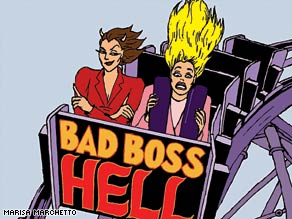
Bad bosses...


We've all had them, and maybe some of us are them! (No, not us!) As a sociologist who has spent many years studying workplaces, I am indebted to a number of bad bosses. Although some of them made my life miserable, they inspired me to understand why. So in the spirit of acknowledgment, I must first say thank you to the boss who told me I was destroying my life by leaving the job to pursue another direction. (Destroying whose life?) And thank you, too, to the psychotic boss who knew that I supported a particular political cause, and out of nowhere screamed at me, "Don't ever let me see you on television with a sign in your hands supporting that Communist (crap)." Whoa! It hadn't occurred to me, but now that you mention it...And thank you to the newly appointed manager who, in her first month on the job, falsely accused me of serious financial improprieties. (One month, and many sleepless nights later, I was vindicated.)

Given these experiences, it has been therapeutic to study the American workplace and to dissect some of the problems that contribute to "bad-bossism." Despite having been "stung" by a few bad bosses, I still believe that people - including some bad bosses - are basically good.

So what is it that leads some people in management positions to "behave badly?" Well for a start, the workplace is a microcosm of our larger culture and society. Societal problems that exist outside the office are likely to surface within it as well, playing out via power dynamics between and among employees, based on their occupational status, their gender, and their racial and ethnic backgrounds.

Political economist and philosopher, Karl Marx, laid the groundwork for understanding the intrinsic tension between labor and management (or, as he would say, capital), in which a capitalist system favors profit over people. In this system, he argued, management would necessarily exploit workers with long hours and poor working conditions, in order to get more productivity out of workers, which in turn would maximize profit. With the advent of laws that limit working hours in manufacturing settings, and the regulation of working conditions, Marx's critique and analysis continues to provide a useful framework, even though it's probably more relevant to manufacturing work in Third World countries, where many multinational corporations have moved their operations in search of cheaper labor.

In the U.S., our current economy has increasingly shifted to knowledge-based work and services, and the lines that are drawn between workers and managers are often painted as more subtle. Nonetheless, stratification of the labor force ripples through multiple levels of professional and managerial workers. How do these dynamics affect the contemporary workplace?

Studies suggest that a number of factors shaping workplace environments contribute to the "bad boss" phenomenon:

1. Male model of the ideal worker
In this model, the "normal" trajectory of the worker is based on a "male model" of the ideal worker, a person who can work throughout his (her?) career in a continuous and uninterrupted manner, taking no time for non-work (e.g., personal, family) activities. Sociologist Erin Kelly, et al calls it a "masculinist work culture", commenting,


"Working long hours is a sign that employees are readily available and eager to meet others' needs; it further reinforces the ideal worker as someone - most often a man - who does not have, or does not attend to, other pressing commitments outside of work."


With this model, work comes first. When managers perceive that's not the case for one or more employees, it's viewed as an affront to the company, a deviation from employee loyalty. Managers who "buy into" a "masculinist work culture" are likely to be critical of workers who challenge this norm. In a study I conducted on parental leave policy in a large financial services company, the norm was so powerful that men chose not to use the company's generous parental leave policy, and women who used the policy took very short leaves, even though legally, all employees were entitled to longer leaves.


2. Structural issues that create a culture of competition
in our current American workplace, where the bottom line rules, there are economic pressures to produce. In line with the prevailing capitalist ethic, a culture of competition is viewed by many managers as necessary to foster productivity, with long hours as the norm. In order to sustain productivity, managers feel pressure from above to push employees to produce more, even when they realize that it's not humanly possible. In a number of the workplace studies I've conducted, I've learned that being in a middle managerial position is often isolating. This makes these managers depressed and grumpy. Most have little support to figure out a better way, and they realize quickly that too much empathy for their "subordinates" takes too much time. Ergo, they may "act badly."


3. Poor economic times makes managers even more grumpy
In our crisis economy, the financial pressure is even more intense, and some managers may exhibit more controlling behavior towards their employees. Managers are being more closely monitored on financial performance, and they may be even less likely to take the time to attend to employees' feelings or needs under these conditions.

4. "Deal with it; I did!"
Some managers worked hard to get where they are, and along the way, they experienced a lot of pain themselves. When they get to the top (or close to it), some pass on what is familiar. While many of the managers I've interviewed worked very hard to respond to the needs of those under their supervision, some were less than understanding.

5. Lack of management training
Some managers who are good workers are rewarded by being moved up to management positions. While some organizations prepare their workers for this type of promotion, others fail to prepare them for the pressures they encounter once they are in charge. Without adequate management training, some bosses make mistakes, even lots of mistakes. Sometimes they find themselves in positions of power and it feels uncomfortable. They're being asked to do things with and to workers that they wouldn't have liked themselves. They know that. But they don't know how to challenge or work with the system without jeopardizing their reputation or losing their jobs. This can make for frustration and grumpiness.

6. Personality problems
Some managers just shouldn't be managing people. Their "management style" may look good to upper-level managers because it fits in with a culture of competition and drive. But they may be making the people who work for them miserable. Because of an "us" and "them" dichotomy, other managers may even side with them.


Perhaps we all have a story about the crazy or mean or incompetent boss. Are all managers bad bosses? No, of course not. But the problem is clearly pervasive: Google "bad boss" and you'll find over 7 million citations, with countless workers publicly venting about their negative experiences, and experts offering advice on how to deal with that mean and disrespectful supervisor.


What is a good boss? There's plenty written about good bosses as well. Google "good boss" and you'll find over 14 million citations! Hopefully we've also had them (and maybe even are them!).


Here's an excerpt (slightly tweaked) from an 10/10/10 article in the Chicago Tribute by Mary Schmich about what makes a "good boss."


* A good boss understands that all power is fleeting and borrowed, and doesn't take advantage of this moment.
* A good boss realizes that her/his real power comes not from those above him, but from the rank-and-file.
* A good boss listens, and can see a problem before it turns into a crisis. If it does turn into a crisis, the good boss works with an employee to resolve the situation.
* A good boss understands that your time is important too.
* A good boss is a good communicator, responding to your concerns and questions in person and via electronic communications.
* A good boss treats employees with respect. S/he does not treat people differently based on their occupational status, gender, race or sexual orientation.
* A good boss tries to make everyone feel special and included.
* A good boss is self-aware and tries to understand how his/her behavior affects others.
* A good boss has the courage to deal with problem employees, and does it professionally.
* A good boss tells you when you screwed up and forgives you.
* A good boss does not take credit for your ideas, nor does s/he demand credit when s/he gives you an idea.
* A good boss is not afraid of people as smart as s/he is.
* A good boss sees what you do best, matches your job to your talents, and gives you room to bloom.
* A good boss remembers how s/he felt about bosses before s/he was one.
* A good boss reveals just enough about her/his personal life to remind you that bosses are people too.
* A good boss doesn't take bonuses when the workers can't get a raise.

* A good boss knows how to apologize and how to laugh, sometimes at him/herself.
* And a good boss understands how much we all yearn for a good boss.